Iran war boosts strategic significance of South Caucasus
March 25, 2026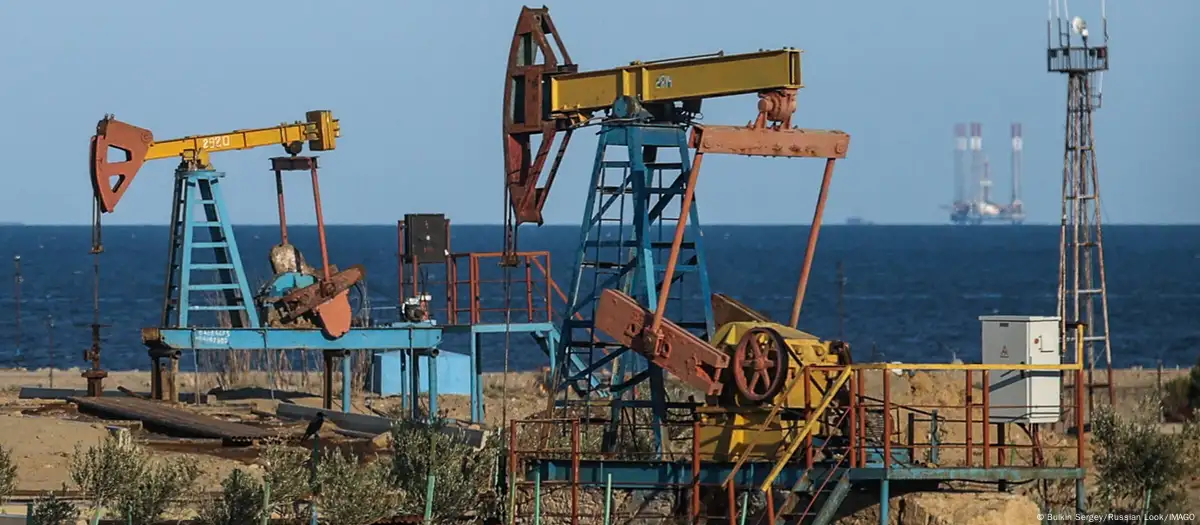
In the hours after the US and Israel began conducting joint strikes on Iran on February 28, air traffic along the normally busy east-west routes was forced into a narrow airspace corridor over the South Caucasus.
What is a new development in the skies has been building on the ground for some time. In recent years, the region has gained attention as a key link in the Trans-Caspian International Transport Route. Also known as the Middle Corridor, it serves to connect Europe and China whilst bypassing Iran and Russia via Central Asia and the South Caucasus.
Now, the Iran war has cast the Middle Corridor's significance into even sharper focus. By shutting the Strait of Hormuz, a route that handles roughly 20% of global oil and liquified natural gas(LNG) shipments, Iran has disrupted global energy flows.
"For this region, this is an opportunity within this crisis,” says Richard Giragosian, director of the Regional Studies Center in Yerevan, Armenia. "The Middle Corridor is now the only route left standing, the only viable path in terms of trade and transport."
A key link in the Middle Corridor
What is more, a major shipping artery through the Bab el-Mandeb Strait and Red Sea, which carries 12% of the world's trade, has repeatedly been disrupted by the Iranian-linked Houthi militiain Yemen. An alternative route around the Cape of Good Hope in South Africa adds more than 10 days to the Asia-Europeroute.
The Middle Corridor — the shortest geographical route between Europe and China — is intended to move Chinese goods along with critical minerals and energy products from Central Asia to Europe. Both the EU and China have already pledged billions to upgrade ports, railways and roads along the route.
Cargo volumes along the corridor have quadrupled since 2022, the year Russia launched its full-scale invasion of Ukraine. Though it still only carries a fraction of Europe-Asia trade, the World Bankestimates that trade volumes could reach a total of 11 million tons by 2030.
Region stands to gain strategic value
Even beyond the current conflict, the Middle Corridor is likely to gain more momentum in the coming years.
"In the mid to long term, the South Caucasus and the Middle Corridor are going to be one of the main routes connecting the EU and China alongside maritime routes," says Kornely Kakachia, a politics professor in Tbilisi. For Georgia, Azerbaijan and Armenia, this shift would elevate their role as pivotal transit states.
For energy-rich Azerbaijan, the Iran war could also bring short term gains. Higher oil prices would mean an export windfall for the country, which analysts have estimated could reach as much as $500 to $600 million extra a monthfor the country.
Hikmet Hajiyev, chief foreign policy adviser to Azerbaijani President Ilham Aliyev, told Euronews that Azerbaijan was increasing its shipments of natural gas to make up for shipments from the Gulf amid the Iran war.
Europe currently receives around 4% of its natural gas from Azerbaijan, equivalent to 12.8 billion cubic meters of gas. This is slated to increase to 20 billion cubic metersby 2027.
Conflict risks instability in the region
But war is also detrimental to business. "In order for the Middle Corridor to be successful, it needs stability from China to the European Union and around the South Caucasus," says Kakachia.
Georgia, Azerbaijan and Armenia have all taken a neutral stance in the conflict. But Iranian officials have long criticized Azerbaijan for its strong economic links with Israel.
In 2025, Israel received 46.4% of its oil from Azerbaijan through the Baku-Tbilisi-Ceyhan (BTC) pipeline. In return, Azerbaijan receives the majority of its military weaponry from Israel.
"Azerbaijan's deepening ties with Israel were always seen as a threat from the Iranian side,” says Mahammad Mammadov, research fellow at the Topchubashov Center in Baku. "But on the other side, Azerbaijan-Iran relations were deepening in recent years. The sides were trying to compartmentalize."
Cooperation between the two countries primarily focused on building a trade corridor between Iran and Russia.
This balance was disrupted on March 5, when four Iranian drones struck an airport in Azerbaijan's exclave Nakhchivan. Azerbaijan's President Aliyev called the strike a "terrorist act," while officials threatened retaliatory strikes, and briefly suspended freight traffic from Iran.
The escalation was ultimately defused after a direct call between the leaders of Iran and Azerbaijan. Still, while "relations are back to normal, the incident created lots of uncertainty," says Mammadov.
Azerbaijani officials also claimed to have thwarted sabotage attempts by Iran's Islamic Revolutionary Guard Crops (IRGC). Among the alleged targets were the BTC pipeline and the Israeli embassy in Azerbaijan.
A prolonged conflict could endanger a flagship Middle Corridor infrastructure project — the Trump Route for International Peace and Prosperity, or TRIPP.
Agreed to as part of a Trump-brokered peace deal between Armenia and Azerbaijan last August, it foresees a 43-kilometer road and rail corridor through Armenia that would connect Azerbaijan to its exclave Nakhchivan and Turkey.
By reopening the border between Armenia and Azerbaijan — shut for decades because of the countries' conflict over Nagorno-Karabakh — TRIPP would create a new logistics corridor alongside existing routes that run through Azerbaijan and Georgia.
The United States, which views TRIPP as a supply chain for critical minerals, has heavily supported the project. It is supposed to be built and managed by a US-led consortium.
But Iran has been skeptical of Washington's involvement in the project, which will run immediately next to Armenia's border with Iran. Last summer, an adviser to the former Supreme Leader Ali Khamenei, went as far as to say that the route would be the "grave of Donald Trump's mercenaries."
These concerns, however, should not be overblown, says Giragosian, pointing out that "in military terms, there is nothing yet to target." Construction on TRIPP is not slated to begin until the second half of 2026.
What Baku wants
Ultimately, says Kakachia, the South Caucasus has a strong interest in maintaining peace and security in the broader region.
Chief among those seeking stability is Azerbaijan. According to Mammadov, "Azerbaijan doesn't want Iran to collapse — or this war to continue longer — because it tips the balance in favor of more uncertainty and miscalculation."
A collapse would "open Pandora's box" — triggering economic instability and potentially an influx of refugees from a country where over 20 million ethnic Azeris currently live.
Instead, Mammadov argues, the most favorable scenario for Baku would be a weakened Iran that nonetheless remains under its current theocratic regime. As long as Tehran is seen as a pariah, Azerbaijan retains its geopolitical and economic value as a stable link between East and West.
Edited by: Srinivas Mazumdaru