Germany updates: CDU push for more voluntary Syria returns
Published September 8, 2025last updated September 8, 2025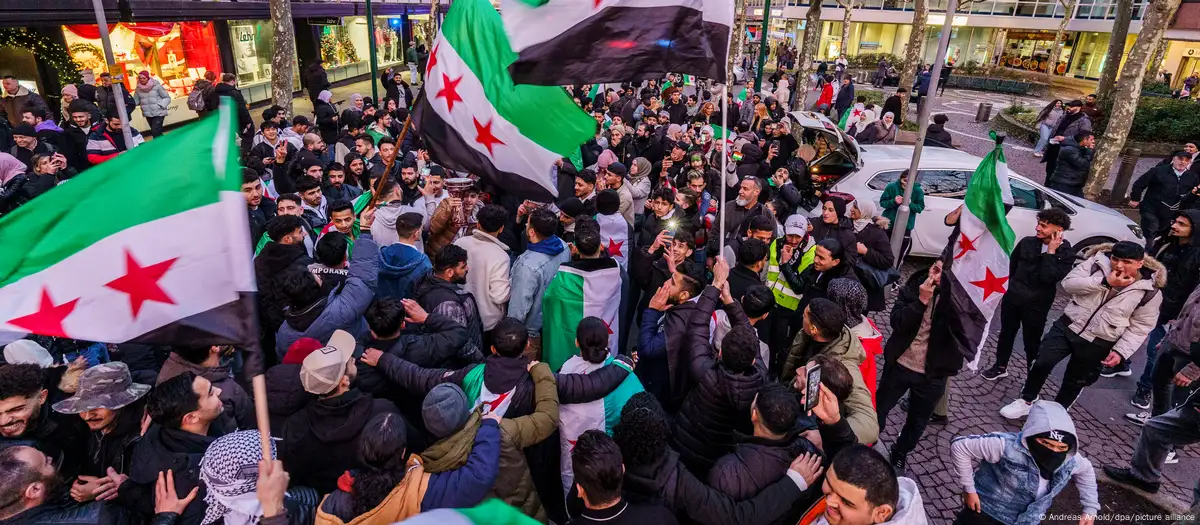
What you need to know
Lawmakers from Chancellor Friedrich Merz's Conservative Democrats are calling for more to be done to make returning home a more attractive prospect for Syrians who have sought refuge in Germany.
So far, only a few refugees from Syria have returned to their homeland since the fall of the Assad regime.
As a result, some conservatives want to promote voluntary departures.
In other news, a Bundestag commission tasked with reviewing Germany's handling of the coronavirus pandemic is meeting for the first time.
This blog has now closed. Read below for news and analysis on a range of issues connected with Germany on Monday, September 8:
Ukraine 'just the start' of Putin's plans for conquest, Merz warns
German Chancellor Friedrich Merz told German ambassadors on Monday that Russian President Vladimir Putin's "imperialist plan wouldn't end with the conquest of Ukraine but would rather be just the start".
He added, "we are experiencing daily and with increasing intensity hybrid Russian attacks, including on our infrastructure."
Speaking in Berlin, Merz also said the liberal world order is under pressure, with a widening divide between democracies and autocracies.
Merz urged a pragmatic, long-term strategy aligned with European interests.
"We are thus faced with very fundamental, indeed historic tasks in creating a new security architecture which, if all goes well, should be sustainable for several decades," the German leader declared..
Söder warns against AfD rise at Bavarian festival
Bavarian state premier Markus Söder on Monday warned against the growing popularity of the far-right Alternative for Germany (AfD).
Speaking at the Gillamoos folk festival, Söder said the AfD’s goal was "clear — to divide, to weaken and to develop a different form of democracy."
Germany's domestic intelligence agency classifies the AfD as a suspected far-right extremist group, although a move to confirm it as extremist is on hold pending a court challenge.
Söder told supporters in Abensberg, north of Munich: "Let's not fall allow our country to be destroyed. No to the AfD taking over Germany and Bavaria."
He rejected calls for an AfD party ban, warning such a move would create a "martyr status" for the group, but cautioned against complacency. "There are right-wing extremists in central positions in the state parliament, and many AfD politicians are under observation by the domestic intelligence service," he said.
Söder leads the Christian Social Union (CSU), the Bavarian sister party to Chancellor Friedrich Merz’s Christian Democrats (CDU). Together, the CDU/CSU bloc are the bigger partners in a ruling coalition at national level with the center-left Social Democrats.
Söder said German liberty was "more fragile than ever" and accused the AfD of seeking "to divide, to weaken and to develop a different form of democracy."
His remarks came as AfD co-leader Tino Chrupalla also addressed the festival, voicing confidence his party would win the 2029 federal election. The AfD, now the largest opposition party, took around 20% in February's parliamentary vote — its best national result to date — and polls suggest support remains high.
Far-right AfD co-leader predicts 2029 election victory
Tino Chrupalla, co-leader of the far-right Alternative for Germany (AfD), told supporters Monday he was confident the party would top the polls in the next general election set for 2029.
"We will get this ship back into shape," he said at a rally in Abensberg, Bavaria. The AfD, now the largest opposition party, scored its best-ever national result in February’s parliamentary vote and last year won a state election in Thuringia — the first far-right victory at state level since World War II.
Chrupalla, who leads the party alongside Alice Weidel, pledged to "paint the country blue" in reference to AfD's colors, and mocked Bavarian conservative leader Markus Söder and Chancellor Friedrich Merz. He accused Merz of breaking "every campaign promise ever made since taking office in May."
Chrupalla and Bavarian AfD leader Katrin Ebner-Steiner also called for mass deportations of migrants without the right to stay. "We will deport, deport, deport until the runways in Munich are glowing," Ebner-Steiner said.
German exports dip in July as US and China demand weakens
Germany's exports fell 0.6% in July 2025 from the previous month, while imports slipped 0.1%, the country's Federal Statistical Office says.
Compared with July 2024, exports rose 1.4% and imports climbed 4.3%. Seasonally adjusted exports totaled €130.2 billion and imports €115.4 billion, leaving a trade surplus of €14.7 billion. That was down from €15.4 billion in June and €17.7 billion a year earlier.
Trade with EU partners increased, with exports up 2.5% and imports up 1.1% from June. Shipments to the eurozone reached €52.0 billion, while exports to non-euro EU countries stood at €22.8 billion.
By contrast, trade with non-EU states declined sharply. Exports fell 4.5% to €55.3 billion, while imports dropped 1.3% to €55.1 billion.
The United States remained Germany's top export destination, but stateside sales fell 7.9% from June to €11.1 billion — the lowest since December 2021 and 14.1% below last year's level. Exports to China slid 7.3% to €6.4 billion, while those to the UK declined 3.1% to €7.0 billion.
On a brighter note, Germany's industrial production grew in July for the first time in four months, rising 1.3% from June, according to the statistics office.
The rebound was fueled largely by a 9.5% surge in machinery and equipment manufacturing, reversing June's 0.1% decline.
Germany no longer most preferred EU destination for refugees
Germany has lost its spot as the most preferred EU country for asylum seekers, seeing the biggest decline in applications with a 43% drop.
The news came as figures were published about overall asylum applications within the bloc.
In the first half of 2025, applications seeking asylum in the European Union dropped by 23%, the Malta-based European Union Agency for Asylum (EUAA) said.
France led with 78,000 applications, followed by Spain with 77,000, Germany with 70,000 and Italy with 64,000.
German states uneven on energy transition progress
Germany's 16 federal states show sharp contrasts in delivering the shift to greener energy, according to new data.
The World Wide Fund for Nature (WWF) assessed each state's performance in renewables, transport, land use and conservation, and buildings and heating.
It found that Brandenburg, Schleswig-Holstein, and Mecklenburg-Western Pomerania were leading Germany's energy transition, with Hamburg, Baden-Württemberg, and Hesse ranked as the furthest behind.
"For the success of the energy transition, the federal states are key. Implementation takes place in the cities, on the meadows, and in the heating cellars," said WWF Germany climate chief Viviane Raddatz.
"At present, progress toward sustainable change in Germany is still a federal patchwork," Raddatz said. "Some states are further ahead in certain areas, but none has tackled the energy transition comprehensively."
She urged the federal government to provide a clear framework for expanding renewables, phasing out fossil fuels, and ensuring the reliable rollout of technologies like heat pumps and electric cars.
German parliament launches inquiry into COVID-19 response
Germany's Bundestag is beginning its formal review of the coronavirus pandemic, with a new parliamentary commission holding its first inquiry session.
The Monday meeting brings together 14 lawmakers and 14 experts. Its task is to draw up a comprehensive picture of the pandemic — its causes, course, consequences and the government's response — and to deliver recommendations by June 2027 to better prepare for future crises.
The commission, chaired by CDU lawmaker Franziska Hoppermann, will examine issues such as mask procurement, vaccine development, business aid programs, and the impact on children and young people. Members include health scientist Rolf Rosenbrock, labor safety expert Isabel Rothe, and intensive care specialist Stefan Kluge.
"The pandemic had far-reaching effects not seen since World War II, and a scientific review of the decisions taken is indispensable," the commission’s mandate states.
Critics argue the commission lacks the investigatory powers of a parliamentary inquiry committee, which can compel testimony and is usually driven by the opposition. Calls for such an inquiry grew louder after a June report sharply criticized then–Health Minister Jens Spahn, from the CDU, over mask procurement. The CDU has rejected the push.
German conservatives seek incentives for Syrian refugees to return home
Germany's conservative Christian Democrats are calling for more incentives for Syrian refugees to return to their homeland.
According to the Interior Ministry, only 1,867 Syrians have returned to their homeland with federal support since the beginning of 2025 — despite the fall of the Assad regime at the end of 2024.
Therefore, some CDU politicians want to promote voluntary departures, making returning to Syria a more attractive prospect than staying in Germany.
"The economic incentive to stay here must not be greater than the interest in contributing to the reconstruction of the country," Marc Henrichmann, CDU interior politician and head of the Parliamentary Control Committee in the Bundestag, told Germany's mass-circulation Bild newspaper.
"We must help stabilize the situation on the ground and cooperate on security issues," Henrichmann demanded.
The number of voluntary departures must increase. "But to do this, we must also be able to tell people with a clear conscience: You can leave," he said.
CDU interior expert Alexander Throm, domestic policy spokesperson for the CDU parliamentary bloc, said the original reason for fleeing — the reign of terror of the Assad regime — had ceased to exist.
He said it was to be expected that Syrian citizens would return to their homeland and participate in reconstruction. This, Throm said, applied especially to those only in Germany for a short time or those who had not yet integrated after many years.
Welcome to our coverage
Guten Tag from the DW newsroom in Bonn.
You join us as Germany's Christian Democrats urge more incentives for Syrian refugees to head back home after the fall of the regime of ousted leader Bashar Assad.
Relatively few Syrians who fled to Germany have returned to Syria with federal support this year.
The CDU's Marc Henrichmann and Alexander Throm have both said voluntary departures must rise, stressing the need for Syrians to contribute to reconstruction.
We will cover any reactions to that, plus other developments in Germany, throughout the day in this blog.