Germany start 2026 World Cup with win over Curacao
June 14, 2026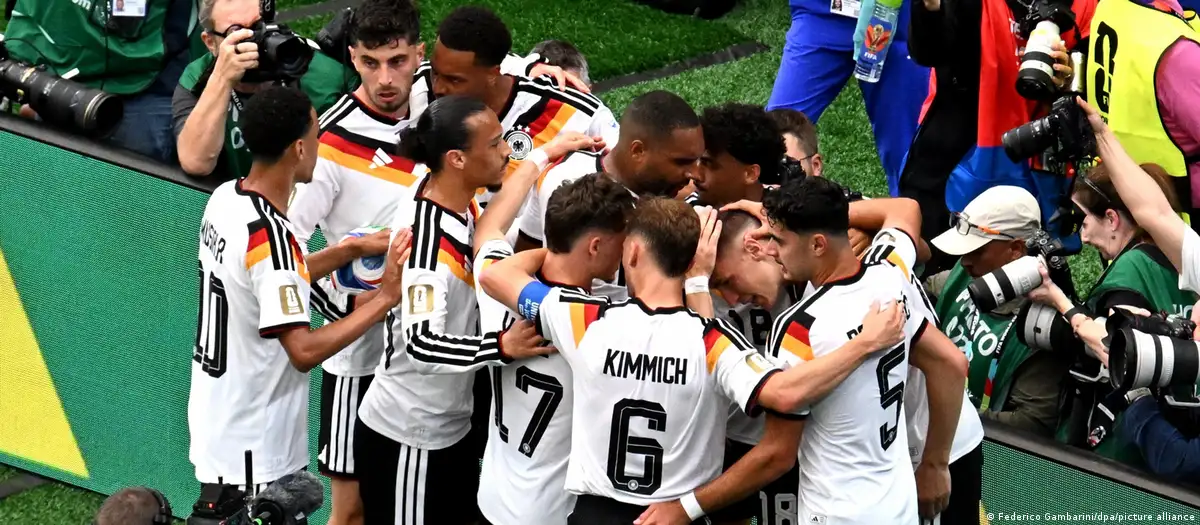
Now that the 2026 World Cup has started, the show of the games is hard to escape. Big stadiums, big screens, big food — this is America and there was no doubt about it in Houston. And Germany did their part by delivering a big scoreline.
The 7-1 win over Curacao was a little short of their highest World Cup win (8-0 against Saudi Arabia in 2002), but matching the famous scoreline of that 2014 World Cup semifinal is a boost to a side that has endured rather than enjoyed recent editions of this tournament.
After weeks of talk about the health of Manuel Neuer's calf, the woes of Qatar and Russia, and Julian Nagelsmann's communication, it was finally time for football.
In the cooled, closed stadium in Houston, Germany cut through the lines faster, found that extra touch sooner and just looked like a team ranked 72 places above their opponents.
"You've got to score seven goals first," Nagelsmann said afterwards, praising his side for matching expectation.
Felix Nmecha impressed in midfield, busying himself all over the pitch. His smartly-taken opener after just five minutes set the tone for Germany. Jürgen Klopp had suggested that maybe Jamal Musiala shouldn't start, but the Bayern Munich player looked extremely lively. There was little sign of rust. His agility on the ball was on another level and his goal after Joshua Kimmich's excellent pass was the perfect accompaniment to an impressive performance.
An equalizer for the ages
Manuel Neuer, who became Germany's oldest ever player at a World Cup by starting this game, was set for a fairly pedestrian afternoon. Until Livano Comenencia's shot hit Kimmich's knee and flew past him. It was a goal for Curacao, but it also felt like a goal for all small nations. The entire Curacao bench was on their feet. Their fans were delirious. Even though the team eventually wilted, their first ever World Cup goal was a moment of history they would remember forever.
Curacao's equalizer came just before the drink's break, which itself felt needless given how cool the inside of Houston's stadium was. For Germany though, it came at a perfect time. There is talk of the game feeling more like four quarters than two halves now and if these breaks are here to stay, this was an example of the impact they can have.
Nagelsmann said afterwards that the break came at a good time for them, and that he was in fact keen to see how the team would respond from the shock given the trauma of previous tournaments.
"You need to take a moment to collect yourself," said Nagelsmann. "I think it’s important to see how the team would handle things after the last two tournaments."
"The water break actually helped us show the players on the board what we had already prepared for beforehand. We encouraged the team to keep playing the way they did in the first 20 minutes."
Germany pull away in the second half
It didn't take Germany long to find that rhythm again, and eventually Nico Schlotterbeck's header found its way past Curacao's 37-year-old goalkeeper Eloy Room. Kai Havertz's penalty before the break extended their lead and then Musiala's excellent finish soon after the restart saw Germany's dominance start to appear on the scoreboard.
Maybe the best news of the day for Nagelsmann was Nathaniel Brown's performance. In very little time at all the Frankfurt defender has made the Germany left back spot — a position that has long been an issue for Germany — his own.
"To score in my first World Cup game is indescribable," Brown told ARD afterwards.
He assisted Schlotterbeck's goal and then added Germany's fifth with a fine volley of his own. This performance explains why Bayern Munich are reportedly keen on Brown. His emergence at this tournament would complete a fairly rapid rise, and would be a huge boost for Julian Nagelsmann.
Substitute Deniz Undav and Kai Havertz added two more as Germany score every ten minutes three straight times. Seven goals, three points and the job done was done.
And yet so much about this team remains unknown. Victory over Curacao, however comprehensive, does not make the identity or future of this Germany team any clearer.
"In German, we have a song, the train has no brakes and we try to do that," Nagelsmann said afterwards.
Well, Germany's World Cup train has left the station on time. In Toronto, against the Ivory Coast, we will likely have a much better idea of how long and how far this train will go.
Edited by: Wesley Dockery