Germany news: Merz still wants US as partner despite changes
Published December 10, 2025last updated December 10, 2025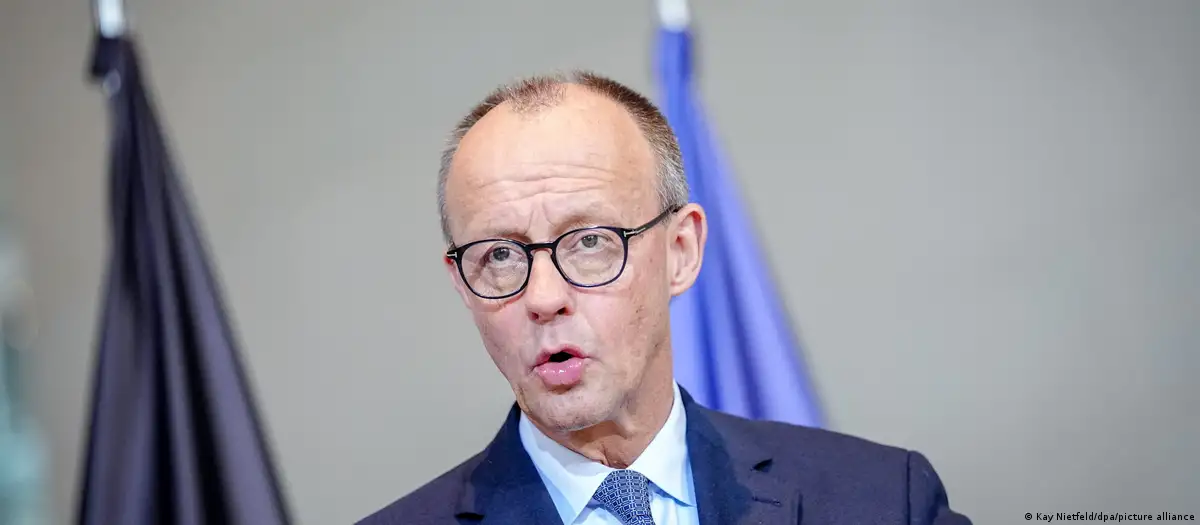
What you need to know
- Chancellor Merz says he still wants to see the US as a partner despite Trump's recent criticism
- Tatjana Haenni becomes the first woman CEO in German football
- German Prince Reuss rejects charges in the alleged coup plot
- SPD general secretary urges expansion of pension contributors
This blog is now closed. Below are the latest headlines, analysis and background from Germany on Wednesday, December 10.
Major oil pipeline spill reported in eastern Germany
State authorities in Brandenburg reported a major oil spill north of Berlin late on Wednesday, saying there had been an accident affecting a pipeline connecting a major oil refinery to the Baltic Sea port of Rostock.
"An accident occurred on the PCK piepline near Gramzow/Zehnebeck, resulting in a large oil spill," a spokesman for Brandenburg's Environment Ministry said. "Emergency services are on site. No information can be provided at this time about the cause of the exact extent of the damage."
Read more about the spill here as additional information becomes available.
Far-right extremists dressed as Santa appear in Munich metro
Commuters in Munich's underground reported seeing people dressed as Santa Claus handing out far-right leaflets on Wednesday.
Munich police said witnesses reported the far-right Santas on the U6 line. The leaflets were designed as "boarding passes" with phrases such as "from Germany to your home country."
The Bavarian security service said it was investigating a group called "Lederhosen Revolt" on suspicion of incitement to hatred.
The group has been linked to the far-right Identitarian Movement, an extremist European movement that has been labeled racist and Islamophobic.
Identitarians view ethnic origin as the only thing that should determine German nationality, and they have openly called for the concept of "remigration," the forced repatriation of immigrant communities and foreign-born German citizens.
Earlier this year, police investigated a regional branch of the far-right populist party Alternative for Germany (AfD) for distributing fake "airplane tickets" to promote the deportation of people to a "secure home country."
Merz says he told Trump about Germany's 'course correction' on migration
German Chancellor Friedrich Merz said on Wednesday that US President Donald Trump's criticism of Europe's migration policy did not apply to Germany. Merz said he has informed Trump repeatedly about Germany's new asylum and migration policies.
"The next time we meet, I will also tell him that we have been very successful in this regard, that we have been able to roughly halve the number of asylum-seekers in Germany," Merz told DW.
"I suspect that he will also acknowledge that we have made a course correction in this area, which has indeed been a considerable burden for us in Germany," he added.
Merz's remarks come after Trump's recent comments about Europe in an interview with US news outlet Politico. The interview follows the release of the new US national security strategy paper, which reassessed the relationship between the US and Europe. The document questioned whether European nations would remain strong US allies.
"Should present trends continue, the continent will be unrecognizable in 20 years or less," the US document said. "As such, it is far from obvious whether certain European countries will have economies and militaries strong enough to remain reliable allies."
Merz still wants US as partner despite changes
In response to US President Donald Trump's recent criticism of Europe, Chancellor Friedrich Merz said on Wednesday that Germany wants the United States to remain a partner, even as transatlantic relations are shifting.
"We are preparing ourselves for a change in transatlantic relations," Merz told reporters.
He added that if Trump "can't make sense of this institution or the structure of the European Union," the US can still cooperate with individual member states.
"Germany is, of course, first and foremost one of them," he said. "I stand by my assessment that America must also have an interest in having partners around the world. We have an interest in having partners around the world, and the United States of America should continue to be one of them."
Regarding the new US security strategy, Merz said the policy did not take him by surprise, particularly following a speech by US Vice President at the Munich Security Conference in February.
"We are preparing ourselves for a change in transatlantic relations," Merz said. "But I would still like to see it as a partnership. And I hope that America sees it the same way from its perspective towards Europe and then also towards Germany."
Additional reporting by Michaela Küfner
Tatjana Haenni the first woman CEO in German football
Tatjana Haenni has been named RB Leipzig's new chief executive.
The appointment makes her the first woman to hold the CEO position at a Bundesliga club.
"I can't wait to get started in January and to get to know the club on a deeper level," Haenni said in a statement released Wednesday.
Read more about Haenni making Bundesliga history with her appointment.
WATCH — German foreign medical worker program mired in bureaucracy
Germany is looking for foreign medical specialists in Latin America with a program that helps them with housing, visas and guidance.
But navigating a rigorous certification process remains a challenge.
German prince rejects charges in alleged coup plot
German noble Heinrich XIII Prince Reuss, the alleged ringleader of the so-called "Reichsbürger" movement, insisted he was "not a terrorist" as he testified in a Frankfurt court on Wednesday.
"I am not a terrorist and did not plan any terrorist acts. I was not a terrorist and will not be one," the 74-year-old told the Frankfurt Higher Regional Court.
The Reichsbürger, or "citizens of the Reich," reject Germany's postwar state, claiming it was installed and controlled by the Allied powers that won World War II.
Members of the group were allegedly planning to storm the German parliament and detain prominent politicians.
"To my knowledge, I have never joined a terrorist group. Therefore, the ringleader Reuss does not exist," he told the court.
Reuss also rejected having "initiated, planned, contemplated or financed a violent military coup."
In his testimony, Reuss described how he was approached by a former soldier and now co-defendant who told him about alleged mass rapes of children in state military facilities.
Reuss is expected to testify again next week.
Trials are also taking place in Munich and Stuttgart, where a total of 26 suspected members of the plot are being prosecuted.
German government approves draft bill against intimidation lawsuits
The German government on Wednesday backed new legislation aimed at shielding journalists and activists from lawsuits filed to silence them.
The draft bill targets cases filed to intimidate individuals who raise issues of public interest, such as corruption or environmental damage.
Such cases, often dubbed "SLAPPs" (Strategic Lawsuits Against Public Participation), exploit the imbalance of power between plaintiffs, such as wealthy businesspeople or lobby groups and independent journalists or activists.
"There is no democracy without a free press, without controversial public debate, without people who speak out and get involved," said Justice Minister Stefanie Hubig, from the Social Democrats (SPD).
"Therefore, we must not allow critical voices to be silenced through intimidation or even threats," she added.
Under the proposed law, the following changes are expected:
-
Courts could dismiss intimidation cases at an early stage
-
Defendants of such lawsuits could get reimbursed for their legal fees
-
The new rules would apply to cases that involve another country
The draft bill would bring German law into line with the EU's recent anti‑SLAPP Directive.
Russian threats prompt calls for tighter German security
"We are not at war, but we are no longer at peace either," is how German Chancellor Friedrich Merz summarized the mood in Germany back in late September.
Ever since Russia's full-scale invasion of Ukraine in February 2022, there has been talk of hybrid warfare among German security and politcal experts.
Find out how Germany's intelligence service is pushing for more powers in the fight against espionage and sabotage.
Far-right AfD welcomes new US security strategy, plans visit
Germany's far-right Alternative for Germany (AfD) party welcomed the new US national security strategy and announced plans to meet Republican allies this week.
"The AfD is fighting alongside its international friends for a conservative renaissance in North America and Europe," said Markus Frohnmaier, AfD's foreign policy spokesman.
Frohnmaier said he is traveling to the United States on Thursday, with meetings in Washington and New York planned.
The visit comes as US President Donald Trump seeks to strengthen far-right European parties, with the new security strategy released last week praising the "growing influence of patriotic European parties."
The 33-page document says the Trump administration will prioritize "cultivating resistance to Europe's current trajectory within European nations."
Frohnmaier told the AFP news agency that the "AfD is building strong partnerships with those forces that advocate national sovereignty, cultural identity and realistic security and migration policies."
The AfD contradicted German Chancellor Friedrich Merz, who said some parts of the security strategy were "unacceptable to us from a European perspective."
SPD calls for broader pension contributions
The center-left Social Democratic Party (SPD) has suggested expanding the pool of contributors to Germany's pension system as part of a planned major overhaul.
SPD General Secretary Tim Klüssendorf told Bavarian public broadcaster BR on Wednesday that the party wants to ensure the system is fair and that "everyone pays their fair share."
He said it should be examined whether politicians, self-employed workers, and future civil servants should also contribute to the pension scheme.
Not everyone agrees with the SPD's approach.
Markus Söder, Bavaria's state premier and head of the Christian Social Union (CSU), rejected the idea of making the self-employed pay into the system.
"They already contribute disproportionately through taxes," Söder told RTL and ntv in the show Frühstart.
He instead called for strengthening private retirement savings, which he said should be "largely tax-free."
Police spot toddler steering car on German autobahn
A police patrol in the state of Rhineland-Palatinate made a shocking discovery after they came across a driver who appeared to be typing on her mobile phone.
While such behaviour would already be hazardous, what they saw on closer inspection stunned officers.
A toddler, less than two years old, was sitting on her lap with both hands on the steering wheel.
Find out how authorities responded to the incident on the German autobahn.
German travel giant TUI reports highest annual earnings in history
Germany's holiday firm TUI, which is Europe's biggest tour operator, has posted record annual earnings, though it expects slower growth next year.
Here's a look at TUI's numbers for the year ending September 30:
-
Annual earnings: €1.46 billion ($1.7 billion), up 12.6% compared with last year
-
Revenue: up 4.4%
-
Pre-tax profit: €1.03 billion, up 20%
-
Next year forecast: earnings to grow 7-10%, revenue to rise 2-4%
The guidance is given "acknowledging the current trading environment as well as prevailing macroeconomic and geopolitical uncertainties," said TUI.
The travel operator noted that early signs were "positive" for summer 2026, "with booked revenue well ahead in what remains a challenging operating environment."
"In a highly competitive market environment, we achieved the best result in the company's history and exceeded the EBIT [earnings before interest and tax] forecast for the full year 2025," said Sebastian Ebel, chief executive of TUI Group.
German students oppose Australia's social media ban
German students have condemnedAustralia's new law banning social media use for under‑16s, calling it the wrong approach.
"The first step should always be to teach young people skills," Quentin Gärtner of the German National Students' Conference.
He added that minors need to learn how to behave responsibly online, rather than simply being blocked.
Australia's new law, which came into effect on Wednesday, requires major platforms such as TikTok, Snapchat, YouTube, Instagram and Facebook to block accounts of users under 16 or face fines of up to A$49.5 million (€30 million).
Gärtner argued that simple age restrictions won't solve the problems.
"If we talk about social media regulations or bans, we need a society‑wide approach," Gärtner, who served as secretary general of the National Students' Conference until November, told the dpa news agency.
"Then we have to say that society as a whole cannot cope with this. But then we need other formats," the 18-year-old added.
He suggested that schools should provide trained professionals who can teach students about healthy sleep habits, the mechanics of social media and how to handle misinformation.
"It's not that we are unaware our screen time is harmful," said Gärtner, adding that millions of children and teenagers are looking for help, hence the demand for guidance is high.
Welcome to our coverage
Guten Tag from the newsroom in Bonn.
The German National Students' Conference has criticized Australia's social media ban for young people under 16, which came into effect on Wednesday. Its former secretary general said age restrictions would not solve the problem.
German holiday giant TUI, Europe's biggest tour operator, has recorded its highest annual earnings.
Follow us here for the latest headlines and developments in Germany throughout the day.