Germany news: Merz seeks good early start in state showdown
Published March 6, 2026last updated March 6, 2026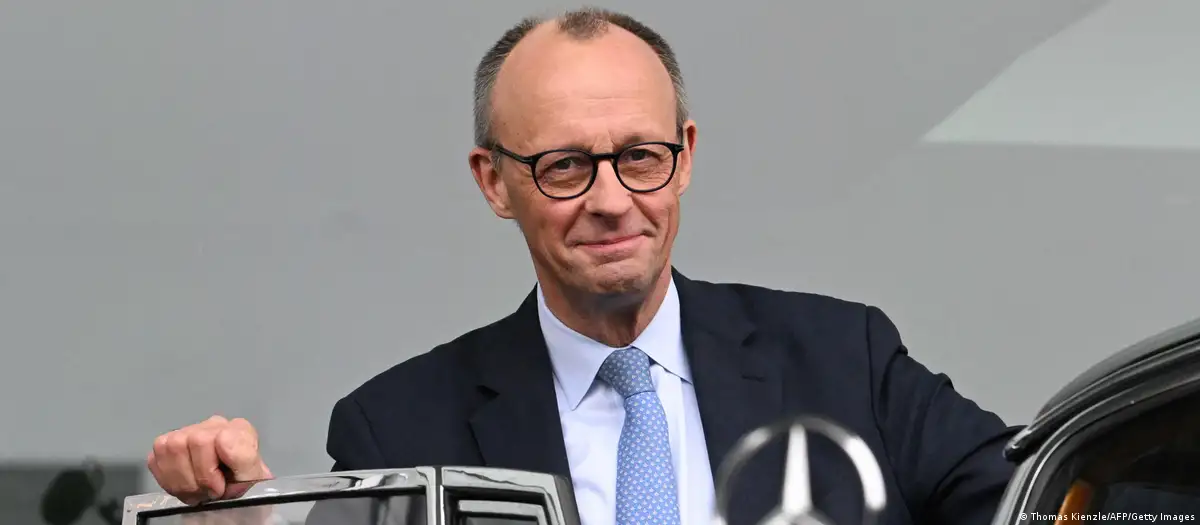
What you need to know
- Chancellor Merz is campaigning in Baden-Württemberg where the first of five state elections this year takes place
- The outcome will be seen as a test of what voters think of his first ten months as chancellor
- Rhineland-Palatinate, Saxony-Anhalt, Berlin, Mecklenburg-Western Pomerania also vote in 2026
- Germany's national airline Lufthansa says the conflict in the Middle East has triggered uncertainty regarding its forecast revenues
These updates are closed. Below are headlines, background and analysis from Germany from Friday, March 6:
Police investigate teenage protester over slur against Merz — report
Berlin authorities are investigating an 18-year-old student suspected of defaming Chancellor Friedrich Merz during a demonstration on Thursday.
The incident was first reported by left-wing newspaper Junge Welt alongside a photo of the student on X.
The teenager reportedly brandished a poster with a vulgar slogan mocking the chancellor at the protest against an increased military recruitment drive.
Officers confiscated the sign and launched a probe on suspicion of "slander and libel against persons in political life," according to a police spokesman quoted by the DPA news agency.
In Germany, the statue of defamation applies when someone knowingly asserts or circulates untrue statements about another person, which are likely to discredit them in public opinion.
The nationwide action on Thursday was held under the motto "School Strike Against Conscription," with thousands of young Germans taking to the streets. The protesters fear a potential return to compulsory military service.
Germany's Axel Springer makes deal to buy UK's Telegraph newspaper
German media group Axel Springer has agreed to buy Britain's historic Telegraph newspaper outfit for 575 million pounds (roughly €665 million, $770 million), the company said.
Springer is acquiring the Telegraph Media Group from investor RedBird IMI, a consortium backed by US and Emirati interests. The Telegraph is one of Britain's oldest and most influential newspapers.
Both sides said the deal, which must still be approved by the relevant authorities, would preserve the integrity of the long-standing media brand while creating new opportunities for growth and expansion into additional markets.
The deal ends a lengthy saga over the fate of the Telegraph Media Group, which publishes the 171-year-old, right-leaning Daily Telegraph as well as its Sunday sister paper.
Axel Springer said it would invest in the group "to enable it to become the leading center-right media outlet in the English-speaking world" seeking to "turbocharge" expansion into the US market.
"More than 20 years ago, we tried to acquire The Telegraph and did not succeed. Now our dream comes true," Axel Springer CEO Mathias Döpfner said.
Conservatives and Greens tied ahead of Baden-Württemberg vote
The race for power in Baden-Württemberg has tightened days before voters go to the polls, with the conservative Christian Democrats (CDU) and Greens now tied in a new survey.
A poll by "Forschungsgruppe Wahlen" for the broadcaster ZDF showed both parties on 28%, with the Greens gaining three points over the past week and the CDU up one point after previously holding a clear lead.
The Greens' surge is driven largely by their candidate Cem Özdemir — a former national government minister with political roots in Baden-Württemberg — whom 47% of respondents said they would prefer as minister-president.
Only 24% backed the CDU's candidate Manuel Hagel, who is far less widely known.
Voters in Baden-Württemberg, located in Germany's southwest, head to the polls on Sunday.
Voter polling suggests the Greens and CDU are likely to continue governing together, though it remains unclear which party will lead the coalition.
Other parties appear set to play smaller roles. The poll puts the far-right Alternative for Germany (AfD) at 18%, the center-left Social Democrats (SPD) at 8%, while the neo-liberal Free Democrats (FDP) and the socialist Left Party both stand at about 5.5%.
In the last state election five years ago, the Greens won a record 32.6%, while the CDU slumped to a historic low of 24.1%. The SPD took 11%, the FDP 10.5%, and the AfD 9.7%, while the Left failed to clear the 5% threshold.
Gas and solar hit record shares in Germany's power mix
Natural gas generated a record share of Germany's electricity last year as renewables slipped slightly, official data showed Friday.
The Federal Statistical Office said gas-fired plants produced 70.6 billion kilowatt-hours in 2025, up 10.2% from a year earlier and accounting for 16.1% of total power generation — the highest share on record.
Solar power also surged, reaching a record 16% of electricity output. Photovoltaic systems generated 70.1 billion kilowatt-hours, a jump of 17.4% from 2024.
Wind remained Germany's top electricity source, supplying 30% of total generation despite a slight decline in output. Coal ranked second at 22.1%.
Germany plans to phase out coal-fired power by 2038 as part of efforts to cut greenhouse gas emissions.
While the previous government under former chancellor Olaf Scholz pushed a rapid expansion of renewable energy, Chancellor Friedrich Merz's conservative-led coalition is planning new gas-fired plants.
Energy Minister Katherina Reiche says additional gas capacity is needed to stabilize the grid when wind and solar output falls.
An analysis by state development bank KfW found that wind and solar together fail to meet demand for an average of just 15 days a year.
Merz to discuss economy in talks with 4 major German business associations
German Chancellor Friedrich Merz is due to meet the heads of four major German business associations in Munich for talks.
The participants include the Confederation of German Employers' Associations, the Federation of German Industries, the Association of German Chambers of Industry and Commerce and the German Confederation of Skilled Crafts.
The meeting will take place on the sidelines of Munich's International Craftsmanship Fair and is likely to center on ideas to sustainably revitalize the German economy.
Germany's economy is experiencing a slower-than-ideal recovery, with no noticeable upswing in sight. Merz's government has revised down its economic growth forecast this year to 1%, down from Economy Minister Katherina Reiche's forecast gross domestic product increase of 1.3%.
Germany's economic woes have only been further complicated by the war in the Middle East, which is expected to further hike oil prices.
The annual meeting between Germany's chancellor and business associations in Munich is a long-standing tradition. This year is Merz's first time attending.
Lufthansa warns of uncertainty amid the Middle East conflict
Germany's national carrier Lufthansa has warned of heightened uncertainty regarding its forecast revenues amid the ongoing conflict in the Middle East.
The conflict unfolded with joint US-Israeli attacks on Iran, which triggered retaliatory attacks from the Islamic republic on the whole Gulf region, causing the biggest air travel disruption since the COVID-19 pandemic.
Airspace across the region, a critical air traffic hub, was forced shut.
"The war in the Middle East proves once again how exposed air traffic is and how vulnerable it remains, even though the industry is now more resilient to crises than it used to be," Lufthansa CEO Carsten Spohr said, as the group announced its 2025 results.
"The massive concentration of global traffic flows via the Gulf hubs is increasingly proving to be a geopolitical Achilles' heel."
Still, Lufthansa acknowledged that shutting down Gulf hubs such as airports in Dubai and Doha in a roundabout way benefited its sales, with long-haul travelers bound for Asia or Africa opting for the German airline as a longer, but safer route.
The group had seen a "sharp rise in demand for long-haul flights" since the conflict started, it said.
Lufthansa is Europe's biggest airline group by sales. It operates Eurowings, Austrian, Swiss and Brussels Airlines, and has also acquired a stake in Italy's ITA.
What's on the cards in Baden-Württemberg's state election?
Baden-Württemberg is Germany's industrial powerhouse and home to leading automakers such as Mercedes-Benz and Porsche.
It's also one of Germany's most popular tourist regions, being known for the Black Forest, scenic spa towns and fairytale castles.
Green candidate Cem Özdemir and conservative Christian Democrat (CDU) challenger Manuel Hagel are competing to replace long-serving state premier Winfried Kretschmann.
The Greens and the CDU have governed together since 2016 and polling suggests a continuation of the conservative-Green alliance remains possible.
The neoliberal Free Democrats (FDP) risks losing its seats for the first time in more than 70 years, while the socialist Left Party could enter the legislature for the first time. The far-right Alternative for Germany (AfD) is expected to become the strongest opposition force, although other parties have ruled out working with it.
Economic concerns are dominating the campaign, with the auto industry in particular facing major restructuring and job losses.
With more than 11.2 million inhabitants as of 2024, Baden-Württemberg is Germany's third-largest state by population, behind North Rhine-Westphalia and Bavaria.
Merz heads south to kick off state election spree
German Chancellor Friedrich Merz is headed to the southwestern state of Baden-Württemberg, where Germany's first state election of this year is set to take place.
The conservative Christian Democrat (CDU) chancellor is headed to Ravensburg, where he is slated to appear alongside Manuel Hagel, the party’s candidate to become state premier.
The vote marks the start of a busy election year across Germany, with four additional state elections scheduled later in 2026.
Losses for the CDU could leave Merz and his governing coalition red-faced on the national stage, while gains for smaller parties could further fragment the political landscape.
Whatever happens, the future promises at least one change with voters set to choose a successor to long-serving state premier Winfried Kretschmann. The 77-year-old Green politician is retiring after 15 years at the helm.
The vote will also introduce two major changes. For the first time, 16- and 17-year-olds can vote, bringing hundreds of thousands of new voters into the electorate. A reformed electoral system will also give voters two ballots — one for a constituency candidate and one for a party list.
Welcome to our coverage
Guten Tag from the DW newsroom here in Bonn as we bring you the latest about Germany.
You join us as Chancellor Friedrich Merz heads south for talks with business groups in Munich about how to ease Germany out of its economic inertia.
He'll then head to Baden-Württemberg where the battle lines are drawn for the first state election of five taking place in Germany this year.
Stay with us for this and other Germany-related headlines from Friday, March 6.