Germany news: Exports jump higher than expected
Published May 8, 2026last updated May 8, 2026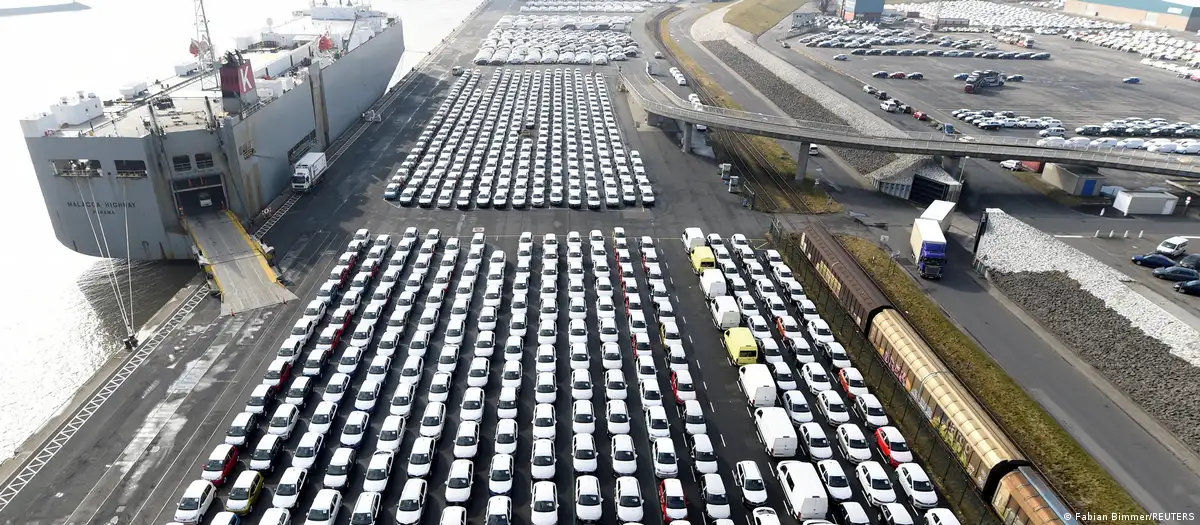
What you need to know
- German exports have risen 0.5% month on month and 1.9% year on year in March, while imports have jumped 5.1%
- Shipments to the US and China have declined sharply
- Germany's Commerzbank says plans 3,000 job cuts to fend off a takeover bid by UniCredit
- A bank hostage situation is unfolding in a western German town
Here are the latest developments from and about Germany on Friday May 8, 2026:
Thousands of school students protest against military service
Across Germany, tens of thousands of school students protested against a possible return to compulsory military service.
Under the slogan "School strike against mandatory military service," rallies and demonstrations took place in dozens of cities on May 8, the anniversary of the end of World War II.
In Berlin, police estimated that around 1,200 people marched from the Brandenburg Gate to the headquarters of the CDU, Chancellor Friedrich Merz's conservative party.
They carried signs that read: "Education instead of bombs" and "Berlin instead of the front lines." Organizers estimated the turnout at 5,000.
In the northern city of Hamburg, organizers estimated that around 6,000 people participated, while police counted approximately 2,300.
In early March, around 50,000 young people participated in a school strike against conscription and compulsory service of all kinds in some 150 cities across the country.
Germany reintroduced a voluntary military service program last year. The law, which took effect on January 1, aims to recruit volunteers to expand the armed forces.
However, if recruitment targets are not met, parliament could reinstate compulsory military service.
A push to criminalize denying Israel's right to exist
Could those denying Israel's right to exist soon face prison sentences in Germany?
On Friday, representatives of the conservative Christian Democratic Union (CDU) presented the Bundesrat, Germany's upper house of parliament, with a draft proposal to introduce a statutory ban under criminal law making it punishable to deny the State of Israel's right to exist.
The debate centered on a draft legislative bill presented by the state government of Hesse, which seeks to enact legislation under which denying Israel's right to exist would be punishable by a prison sentence of up to five years.
To date, under German law, slogans are punishable only if they are accompanied by a call to violence. Were this proposal to be enshrined in law, however, holding up a map at a demonstration on which Israel is crossed out would also constitute a criminal offense and be subject to punishment.
During Friday's debate, Thomas Strobl (CDU), the interior minister of Baden-Wuerttemberg, cited the slogan "From the River to the Sea" as an example. Such slogans, he argued, express an antisemitic worldview and should not be employed "under the guise of freedom of speech and assembly." The German state, he emphasized, must "not tolerate calls for the destruction of Israel or public challenges to its right to exist."
The Bundesrat referred the draft bill to specialized committees for deliberation. The next meetings of the relevant bodies are scheduled for late May, and the proposal could be presented to the plenary before the summer recess.
Germany's constitution, the Basic Law, stipulates that the federal states may forward the bill to the Bundestag, thereby participating in the legislative process.
In a rather unusual turn of events, some 30 law professors have already publicly voiced their concerns, characterizing the proposed measure as unconstitutional. While acknowledging that concerns over rising antisemitism and antisemitic violence are understandable, they argued that a specific opinion cannot be prohibited through a general statute.
Probe opened after incident involving Maddie suspect
German police have opened an investigation after an incident involving a suspect in the Madeleine McCann case.
Authorities in Kiel said proceedings were launched over suspected mutual bodily harm following a reported altercation.
The suspect, Christian B., was said to have been involved in a fight and called police himself, according to media reports. Officials have declined further details due to the ongoing investigation.
Christian B. has been living in a municipal facility in Kiel after his release from prison in Lower Saxony, where he served a seven-year sentence for sexual offenses unrelated to the McCann case. He remains under police monitoring and wears an electronic ankle bracelet.
Prosecutors in Braunschweig have classified him as a suspect in the high-profile disappearance of Madeleine McCann, also known as Maddie, who vanished in 2007 from a holiday apartment in Praia da Luz. No charges have been filed in that case.
Germany sets up army assessment centers
Germany has designated 24 locations for new centers to assess military candidates as it moves to expand the Bundeswehr.
The Defense Ministry said the first site was expected to open later this year as part of a new military service law.
From mid-2027, young people are to be evaluated at the centers for physical, mental and intellectual suitability. Two sites are planned in Kassel and Wiesbaden, with additional centers at existing military locations including Bonn, Dresden, Hamburg and Ulm.
A further eight centers are to be established in cities such as Bielefeld, Dortmund and Regensburg, bringing the total to 24 nationwide.
Germany has been seeking to boost troop numbers in response to Russia's war in Ukraine and updated NATO targets. The country reintroduced a voluntary military service program last year.
Since the start of this year, 18-year-old men have been required to complete a questionnaire assessing their willingness to serve in the Bundeswehr.
States block €1,000 worker bonus plan
Germany's proposed €1,000 bonus for workers has been halted after states rejected the measure via the country's upper house of parliament.
The Bundesdrat — where Germany’s federal states are represented — voted against the plan aimed at offsetting rising energy costs, delivering a fresh setback to the coalition government.
The government has said it remains committed to easing the burden on citizens but has not clarified whether it will trigger mediation talks between federal and state levels. The bonus had been agreed in April as part of a broader relief package responding to the economic fallout from the Iran war.
The plan faced strong resistance from both businesses and state governments, which criticized how costs would be shared and the lack of clarity over who would receive the payments.
Hostages freed at bank in Sinzig after suspects flee scene
Police said a hostage situation was over at a bank in the western German town of Sinzig, with no injuries.
Read more about how the hostage situation was resolved .
Commerzbank targets growth, cuts 3,000 jobs to fend off takeover bid
Germany's Commerzbank has been stepping up its defense against a takeover bid by finance giant UniCredit by raising targets and planning 3,000 job cuts.
Commerzbank CEO Bettina Orlopp said the strategy aimed to boost performance and make any acquisition too expensive.
The bank plans to reduce around 3,000 of its 38,000 jobs, partly due to efficiency gains from AI, while investing about €450 million to ensure socially responsible cuts. It has already eliminated 10,000 roles since 2020.
UniCredit, led by Andrea Orcel, has built up a stake of more than a quarter and secured options for a larger holding, intensifying takeover pressure. Germany’s chancellor Friedrich Merz has backed Commerzbank, criticizing what he called aggressive tactics.
Despite weak economic conditions, Commerzbank has raised its long-term targets, aiming for revenues of Commerzbank €16.8 billion by 2030 and a net profit of €5.9 billion. Strong first-quarter results have exceeded analyst expectations, even as the share price slipped in early trading.
German exports edge up despite global tensions, tariffs
German exports have risen slightly despite ongoing global tensions linked to the Iran war, despite a drop in shipments to the United States.
The Federal Statistical Office said exports for March increased 0.5% month on month and 1.9% year on year in adjusted terms.
Imports have jumped more sharply, rising 5.1% from February and 7.2% compared with a year earlier. Germany recorded exports worth €135.8 billion against imports of €121.5 billion, leaving a trade surplus of €14.3 billion, down from €19.6 billion in February.
The US remained Germany's most important export market, though shipments there have dropped significantly. Exports to the US totaled €11.2 billion, down 7.9% from the previous month and 21.4% compared with March 2025. Exports to China also declined by 1.8%. Demand has shifted toward the EU, where exports rose 3.4%, and the UK, up 3.2%.
The Iran war has fueled uncertainty across Germany’s export-driven economy, with higher oil prices increasing transport costs. That has weighed on expectations for a stronger recovery.
The government has cut its growth forecast for the year by half to 0.5%. Trade tensions have also resurfaced, with Donald Trump threatening new tariffs, raising the risk of a renewed EU-US trade dispute.
Germany's exporters had rebounded earlier in the year, with strong gains in February and a recovery in 2025 driven by a robust December. However, the German Chamber of Industry and Commerce now expects exports to stagnate in 2026 instead of growing by 1.0% as previously forecast.
Welcome to our coverage
Guten Tag from the DW newsroom in Bonn.
You join us as there is news that German exports have been better than expected, even as sales to the United States take a dip.
Meanwhile, one of Germany's major banks has said it plans to cut jobs as it fights a takeover by an Italian rival.
Stick with us here for these stories and more of what Germany is talking about today.