France: Prime Minister Bayrou ousted in confidence vote
Published September 8, 2025last updated September 8, 2025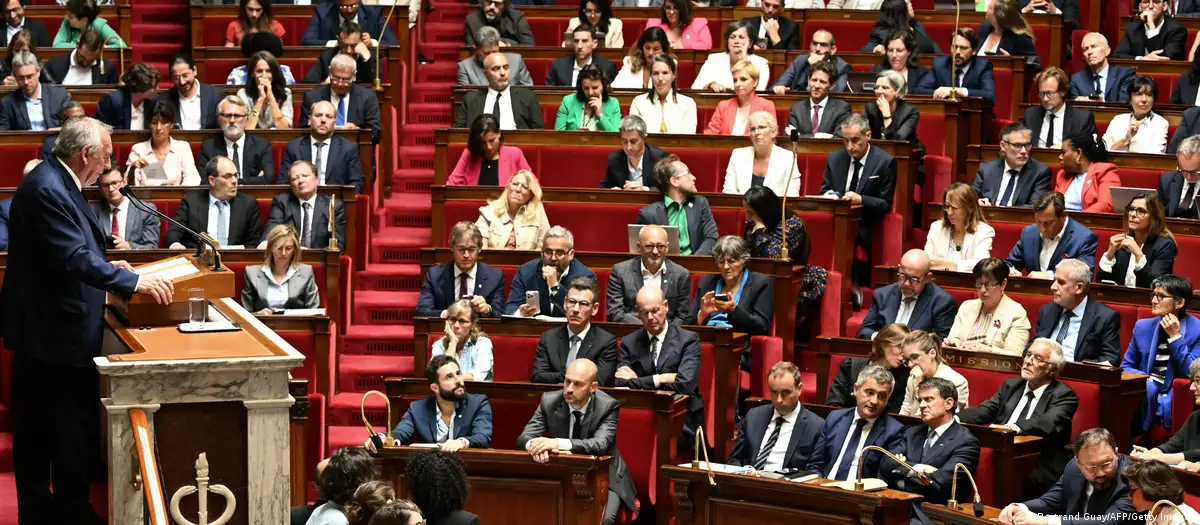
What you need to know
- Prime Minister Francois Bayrou loses confidence vote
- Bayrou to submit resignation to President Emmanuel Macron's early Tuesday
- Bayrou is Macron's fourth prime minister in less than two years
This is a roundup of coverage of developments in France on Monday, September 8. This blog is now closed.
We are concluding our coverage
We’re ending our coverage for today, but we will continue to monitor France as the fallout from today unfolds.
France's government has collapsed after parliament rejected Prime Minister Francois Bayrou's debt-cutting plan.
Lawmakers voted overwhelmingly to oust Bayrou, deepening a political crisis in the eurozone's second-largest economy.
President Emmanuel Macron now faces the task of appointing his fifth prime minister in under two years.
Bayrou will formally resign on Tuesday, leaving Macron to navigate a fractured parliament and rising debt.
The French president will name a new prime minister in the coming days.
Centrist politician calls for Macron to appoint 'negotiator' rather than PM
Centrist lawmaker Gabriel Attal is calling for President Emmanuel Macron to hold off on naming a new prime minister after Francois Bayrou's ouster on Monday.
Attal is the leader of the Renaissance faction within Macron's Ensemble alliance and served as prime minister from January to September of last year.
"I propose that [Macron] appoint a negotiator, stating from the outset that he will not be prime minister," Attal said in a post on X.
He said that such a negotiator would be tasked with bringing political parties together to hash out a general agreement.
"This compromise would then allow for the appointment of a prime minister," he said, adding that the new premier would be the "guarantor" of the agreement.
"Let's start by talking about the 'what' before talking about the 'who'," he said in a video accompanying his X post.
France has gone through three prime ministers over the last 12 months, with Macron's faction struggling to form government since July 2024's legislative election resulted in a hung parliament.
Macron to name new prime minister 'in coming days'
President Emmanuel Macron has acknowledged Prime Minister Francois Bayrou's ouster, the Elysee Palace said.
The president will appoint Bayrou's successor "in the coming days," according to the statement.
How many lawmakers voted against Bayrou's government?
Prime Minister Francois Bayrou suffered a resounding defeat in Monday's confidence vote, with nearly two-thirds of the National Assembly supporting his ouster.
A total of 364 lawmakers voted against Bayrou, while 194 expressed their confidence in the government.
Bayrou's ouster did not come as a surprise as opposition parties from across the political spectrum had expressed their intention to vote against his confidence motion.
Bayrou had run a minority coalition government, with only 210 seats in parliament.
France Unbowed to seek Macron ouster
After Francois Bayrou's ouster as prime minister, Mathilde Panot of the left-wing France Unbowed (LFI) said her party would present a motion to oust President Emmanuel Macron.
She said that the no confidence vote showed that Bayrou's "budget of social violence and cruelty has been defeated," while accusing his and President Emmanuel Macron's centrist faction of implementing "policies for the rich."
Panot said that Bayrou had governed without taking into account the results of last year's legislative election, in which the left-wing New Popular Front (NFP) bloc emerged as the largest force in parliament.
She expressed her party's support for the "Block Everything" movement, which is calling for a general strike and nationwide shutdown on September 10 in opposition to Bayrou's proposed austerity measures.
No-confidence vote 'massive rejection' of Bayrou government — Socialists
Boris Vallaud, the head of the center-left Socialist Party in the French parliament, said Prime Minister Francois Bayrou had been met with "massive rejection" in Monday's confidence vote that resulted in the premier's ouster.
He said that Bayrou's comments during the parliamentary debate leading up to the vote showed the outgoing prime minister had not "drawn the necessary conclusions" or admitted his and President Emmanuel Macron's responsibility for the "serious budgetary and financial situation the country is in."
He said that the Socialists had attempted to reach a "compromise" with the government, but had received "indifference" and "silence" in response.
Vallaud called for a "new political path" that would move away from President Emmanuel Macron's policies.
What happens now?
Now that Francois Bayrou's government has fallen, the prime minister must hand in his resignation.
President Emmanuel Macron will then need to either choose a new prime minister or call snap elections.
While certain factions, particularly the far-right National Rally, have argued in favor of new elections, members of the left-wing New Popular Front (NFP) alliance are urging for Macron to appoint a prime minister from the left.
New elections are unlikely to result in a more favorable parliament for Macron, as his centrist alliance is currently suffering in the polls.
Bayrou is a member of Macron's centrist faction and had governed in coalition with center-right parties, such as the conservative Republicans.
French Prime Minister Francois Bayrou loses confidence vote
French Prime Minister Francois Bayrou has lost a no-confidence vote in parliament over his government's planned austerity measures.
In a vote in the National Assembly, 364 deputies voted that they had no confidence in the government while just 194 gave it their confidence.
"In line with article 50 of the constitution, the prime minister must submit the resignation of his government," said speaker Yael Braun-Pivet.
Bayrou is expected to hand in his resignation to President Emmanuel Macron on Tuesday.
Following Bayrou's ouster, Macron must choose a new prime minister or call new elections.
Lawmakers begin to vote in confidence proceedings
Following three hours of debate, French lawmakers have begun to vote in confidence proceedings that are likely to lead to the collapse of Prime Minister Francois Bayrou's government.
The vote is to end at 18:50 local time (16:50 UTC).
WATCH: French parliament set to eject PM in blow to Macron
French Prime Minister Francois Bayrou has requested a no-confidence vote in parliament. Bayrou is facing backlash over his austere budget plans, which he justifies by citing the country's debt crisis. DW's Lisa Louis reports on the latest developments.
France Unbowed accuses Macron of 'alliance' with far-right
Speaking ahead of a confidence vote likely to cause the fall of Prime Minister Francois Bayrou's government, Mathilde Panot of the left-wing France Unbowed (LFI) party accused President Emmanuel Macron's centrist alliance of maintaining a tacit "alliance" with France's far-right.
She said that Macron and Bayrou's centrist faction, the right and the far-right all agreed on implementing cuts to social welfare spending and anti-environmental policies, while also maintaining an "Islamophobic consensus."
Panot criticized Interior Minister Bruno Retailleau of the conservative Republicans, accusing him of not doing enough to crack down on far-right and misogynist violence in the country.
She accused Israel of committing genocide in the Gaza Strip, saying that the French government had not done anything to prevent it.
The LFI politician accused Paris of implementing "neo-colonial" policies in its overseas territories such as New Caledonia and Guadeloupe.
Le Pen calls for snap elections
Marine Le Pen, the parliamentary leader of the far-right National Rally, called for President Emmanuel Macron to call snap elections, with the collapse of France's government likely imminent.
"In these circumstances, the president only has one option: to call new elections and let the country choose," she said.
"The dissolution [of parliament] is not an option for Macron, but an obligation," she declared.
She said that France was facing the "result of five decades of lavish governance" that was leading to the "collapse of a system."
Le Pen celebrated Prime Minister Francois Bayrou's likely loss in the upcoming no-confidence vote, saying it would mark the end of the "agony of a phantom government."
"What's the point of keeping a government that isn't governing?" she asked.
While also echoing Bayrou's concerns over France's budget deficit, Le Pen said his and Macron's political faction was "responsible" for the debt.
She also took aim at a potential left-wing government, saying it would raise taxes and allow the entry of more migrants.
The left-wing New Popular Front (NFP) has called for Macron to appoint a member of the alliance as prime minister, as it was the most voted bloc in the last legislative election in July 2024.
Environmentalists call for 'break' with Macron's policies
Cyrielle Chatelain, the parliamentary head of the environmentalist faction within the left-wing New Popular Front (NFP) alliance, said that French Prime Minister Francois Bayrou's resignation would be a "relief."
"In a couple of hours, you will present your resignation to the president of the Republic, without causing any sadness or regret," she said, addressing Bayrou.
She called for France to "break" with the policies of President Emmanuel Macron, saying that they had been "rejected at the ballot box."
The environmentalist called for Macron to "appoint a prime minister from the ranks of the [NFP] in order to change course," saying that it would be the only way to get out of France's political "impasse."
"We will replace austerity with financial justice," she declared.
The leftist alliance emerged as the largest bloc in July 2024's legislative election.
Chatelain called for the Macron and Bayrou's centrist Ensemble group to end its alliance with right-wing parties, arguing that otherwise it would become a "prisoner" of the far-right National Rally.
French socialists slam Bayrou and Macron, demand premiership
Having heard Prime Minister Francois Bayrou's general policy statement and plea for support, it's now time for the leaders of other National Assembly groups to respond.
"You like the truth? Well, here it is," says Boris Vallaud of the socialist bloc, blaming President Emmanuel Macron for "improverishing the poor, enriching the rich, and turning his back on the future."
Vallaud calls the policies of Bayrou's government not only "a fatal error, but a moral failing" and says the prime minister's decision to table a confidence vote "not an act of courage, but of ducking responsibility."
As we reported earlier, the socialists and other parties on the left have believed ever since the elections last July that they, as the biggest bloc, ought to head up the government.
"It is now up to the left, which came out on top [last year] to govern, and to those who want to assume their responsibilities to take the initiative," he says. "As Socialists, we will not shy away from this."
'Far left' is France's 'biggest threat,' claim Republicans
Next up is Laurent Wauquiez of the center-right Republican Party (Les Républicains) who, while also no fan of Prime Minister Bayrou's government, claims that the "far left" is "the greatest political threat to our country."
"We will never accept a government that includes members of [the hard-left] France Unbowed and Socialist lawmakers who would promote the New Popular Front's agenda," he said.
The so-called New Popular Front (NFP), a coalition of parties from across the left-wing spectrum, spectacularly emerged from last July's election second round as the biggest party in the National Assembly with 180 seats.
Wauquiez's Republicans came fourth with just 39 seats, having hemorrhaged votes to the far-right National Rally (the third biggest party with 142 seats).