Climate change leaves ski slopes skimpy across Europe
Some forecasters say this winter's snowfall will be like in the "good old days," while others argue long-range projections are no longer reliable. Europe's ski hills are clearly feeling the impacts of climate change.
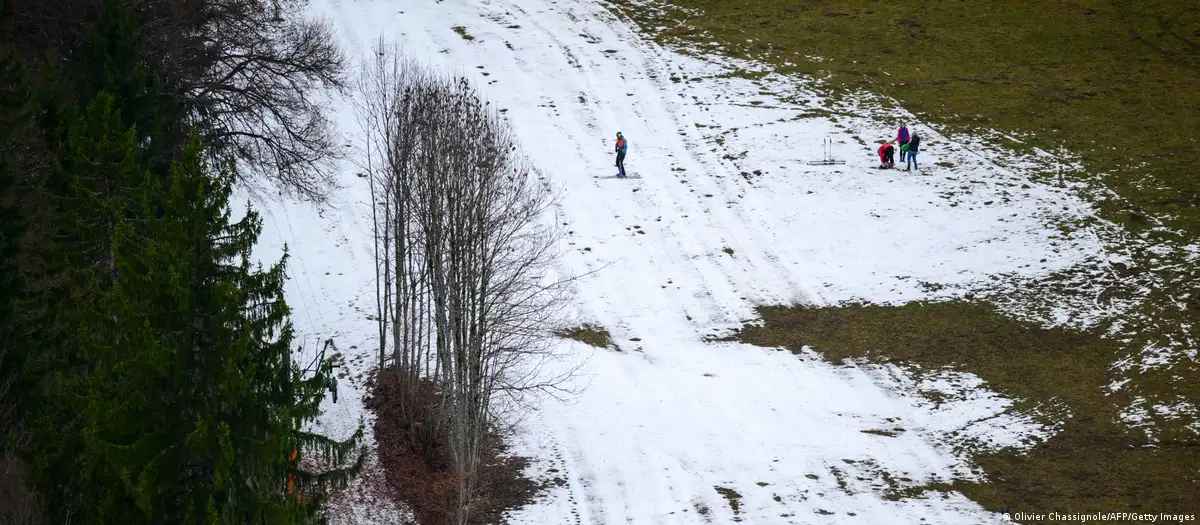
Fewer snow days
According to data from the European Environment Agency, snow thickness has been reducing by about 12.2% every decade and that decrease has recently been accelerating. Other studies show that what is known as "snow persistence," or how long snow stays on the ground, is falling by about 0.44 days per year. This is also described as having fewer "snow days."
Essential equipment
According to a study in the journal "Nature," about 1,200 ski resorts in 28 European countries are at risk of closure as average global temperature rise nears 2 degrees Celsius (3.6 Fahrenheit) above pre-industrial levels. Snow machines have become an essential tool for ski resorts.
No-go without snow
Without snowmaking equipment, more than half of the 2,234 ski resorts studied in 28 European countries are projected to be at very high risk for insufficient snow supply, the researchers reported.
Worrying environmental impact of artificial snow
The problem with snowmaking is that it uses a lot of water and power. You need about 1,000 liters (250 gallons) of water to make about 2.5 cubic meters of artificial snow, according to the International Commission for the Protection of the Alps. Additionally, snowmaking becomes far less effective as temperatures rise so it cannot be seen as a cure-all.
Abandoned in the Alps
According to "Nature," Italian ski resorts are at most risk. Ninety percent of slopes there are dependent on artificial snow, according to the Italian environmental association Legambiente. The organization reports that, in 2025, 265 ski stations were abandoned in Italy. The next-worst affected countries are Austria, Switzerland and France (Puyvalador pictured here in January 2023) and Germany.
'Ghost stations'
Ceuze, in the French Alps, is what has come to be described as a "ghost station." The resort first opened 85 years ago, but was forced to close in 2018 after a lack of snow. And Ceuze (pictured here in June 2024) is not the only one: 186 ski resorts in France have closed due to reduced snowfall. Only ski fields at higher elevations are now assured of enough snow to draw visitors.
Billion-euro industry at risk
The closure of ski hills changes mountain communities and has an impact on the European ski industry. This represents about half of all ski areas in the world, sells over 200 million ski passes every season and is worth about €30 billion ($35 billion). Pictured here is Portes du Soleil in France in March 2023.
Less snow, bigger queues
With less snow, fewer slopes are open, and this winter there have been reports of queues for ski lifts that last for hours, as disgruntled visitors try to get onto the runs that are open. Pictured here is the Portes du Soleil winter sports resort in France in March 2023.
Less snow, more water shortages
The lack of snow not only affects the ski industry — it also means less water in spring, such as here at Germany's Garland reservoir in April 2024. Snow acts as a kind of natural reservoir for fresh water. It is estimated that around the world 2 billion people depend on snow-fed water basins. In Europe, areas most affected by snow-fed water are around the Mediterranean and in countries like Spain.