WHO chief visits Ebola epicenter in eastern DR Congo
May 30, 2026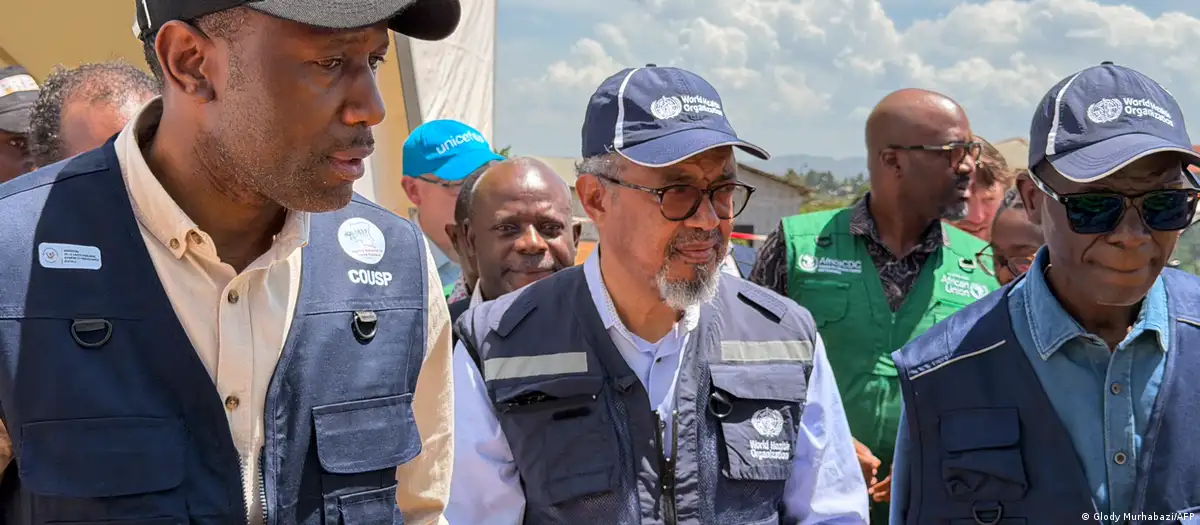
What you need to know about the Ebola outbreak
- The epicenter of the Ebola outbreak is in Ituri province in eastern DR Congo
- Ebola has also been detected in other parts of eastern DR Congo and in Uganda
- DR Congo has recorded at least 1,077 suspected Ebola cases and 246 deaths
- The outbreak was declared on May 15
- Health officials warn that the actual spread of the disease could be much larger
The head of the World Health Organization (WHO), Tedros Adhanom Ghebreyesus, arrived on Saturday in the Democratic Republic of Congo's eastern Ituri province, which is facing a severe Ebola outbreak.
He traveled to Ituri after meeting Congolese officials in the country's capital, Kinshasa.
Besides Ituri, Ebola cases have also been detected in the eastern provinces of North Kivu and South Kivu, as well as in neighboring Uganda.
Tedros is expected to visit a treatment center and meet local authorities, health workers and affected families in Ituri's provincial capital, Bunia.
The Bundibugyo variant of the disease that is driving the current outbreak has no approved treatment or vaccine.
What is the state of the Ebola outbreak in DR Congo and Uganda?
DR Congo has registered at least 1,077 suspected cases of Ebola since the outbreak was declared on May 15, according to the Africa Centers for Disease Control and Prevention.
The disease is believed to have led to the deaths of at least 246 people, according to the latest data from the Africa Centers for Disease Control and Prevention.
The outbreak is centered in the country's northeast, in a war-torn area that borders South Sudan and Uganda, which closed its border this week. At least nine cases have been confirmed there, and one death has been reported in the capital, Kampala.
Ebola spreads between people through contact with the bodily fluids of an infected person or contaminated objects.
It can take up to 21 days for symptoms to show, according to the WHO, which has warned that the reach of the outbreak is likely to be much wider.
DR Congo's response to the outbreak has been hampered by cuts to international development aid, and the WHO's own funds have been limited after the United States withdrew from the body in January.
Eastern DR Congo has also been grappling with armed conflict for three decades.
Fighting between Kinshasa's forces and the Rwanda-backed M23 militia reignited in 2022, with the rebels taking large swathes of eastern DR Congo, including major cities in North and South Kivu.
While DR Congo reached a US-brokered peace deal with the armed group in 2025, fighting has continued.
What did Tedros say about the outbreak in Ituri and eastern Congo?
The WHO chief emphasized the importance of international cooperation with Congolese authorities and local communities.
"The international community is involved under the leadership of the government of DRC — and at the same time community ownership is important," Tedros told reporters.
"That's why we are here to discuss with the community, to see how the response is running and if there are challenges to help."
Tedros also urged countries to reconsider border control measures introduced to tackle the outbreak.
"Closing borders, as some countries have done, only discourages transparency. The Democratic Republic of Congo is reporting the situation openly and transparently," he said.
Edited by: Karl Sexton
Don't let the algorithm hide the news. If you rely on our team for trusted reporting, please take a moment to select us as your Preferred Source on Google by clicking here and hitting the "star" or "preferred" button, so you'll always see our verified news first.