Nepal's farmers start rice season amid harvest fears
Nepalese farmers celebrate the arrival of the monsoon with Asar Pandra, the festival of rice sowing. But this season, below-average rains are expected, and crops may be in danger.
Farmers' festival
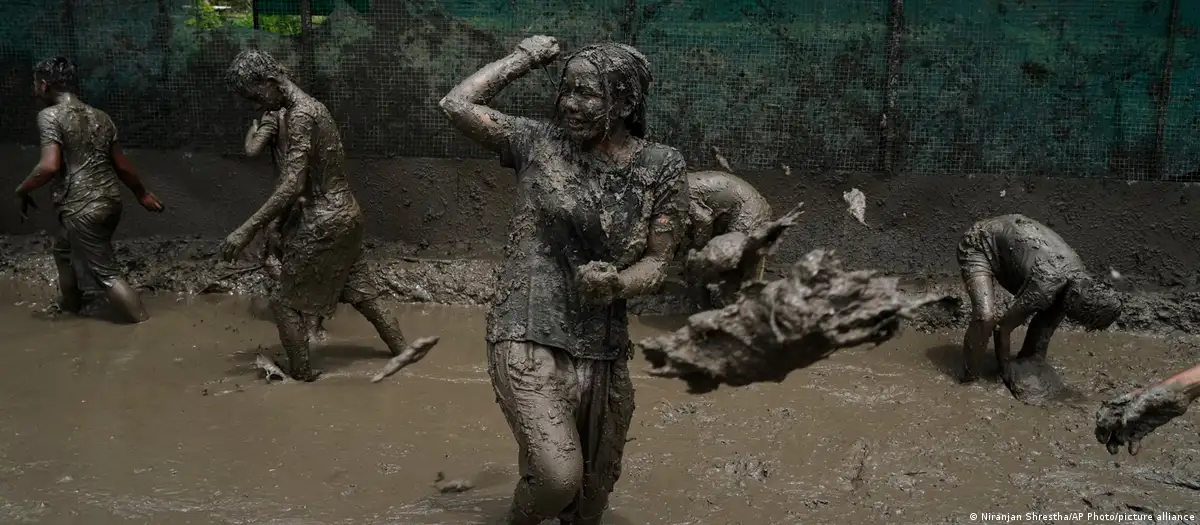
The rice-sowing festival Asar Pandra is celebrated throughout Nepal, with the start of the monsoon rains marking the beginning of the rice season. Farmers and their families gather to plant rice seedlings together — and to splash around in the mud. The festival is a national holiday, though this year the rains arrived later than usual.
Fieldwork and feasts
This woman is planting rice in the flooded fields near Kathmandu, Nepal's capital. Once the seedlings are in the ground, the villagers splash around in the muddy fields, followed by a feast. The celebration takes place every year on the 15th day of the Nepalese month of Asar. In the Gregorian calendar, this day usually falls on June 29.
Cracked by the climate
But most rice fields had to be artificially irrigated for sowing this year. The weather phenomenon El Nino, which occurs when ocean temperatures in the central and eastern Pacific Ocean rise above normal and bring hot, dry weather to the region, is possibly to blame. El Nino changes precipitation patterns in large parts of the world, including Nepal.
Flooded fields
Nepal experiences a paradoxical mix of acute flood risk and fear of drought. The weather patterns triggered by El Nino can vary greatly from region to region: some places may experience droughts, while others may be affected by floods.
Disaster warnings
The effects of El Nino are already being felt. Although the monsoon season started late and international climate research institutes are forecasting below-average total precipitation, the Nepalese weather service is reporting heavy rainfall in some areas. Disaster warnings are in effect in several parts of the country.
Staple crop
Rice is a staple food for millions of Nepalis. The crop is typically planted once a year in early summer, and harvested about four months later. There is a fixed gender-based division of labor: while the men plow the fields, rice cultivation itself is in the hands of women.
Backbreaking work
Farmers transplant the rice seedlings into the muddy soil through painstaking manual labor. In Nepal, women are also traditionally responsible for the harvest. This year, massive harvest losses are expected in large parts of Asia due to El Nino, including in Nepal. Meteorologists warn that this could be the strongest El Nino ever recorded.