OECD: Development aid plummets in 2025 amid USAID gutting
April 9, 2026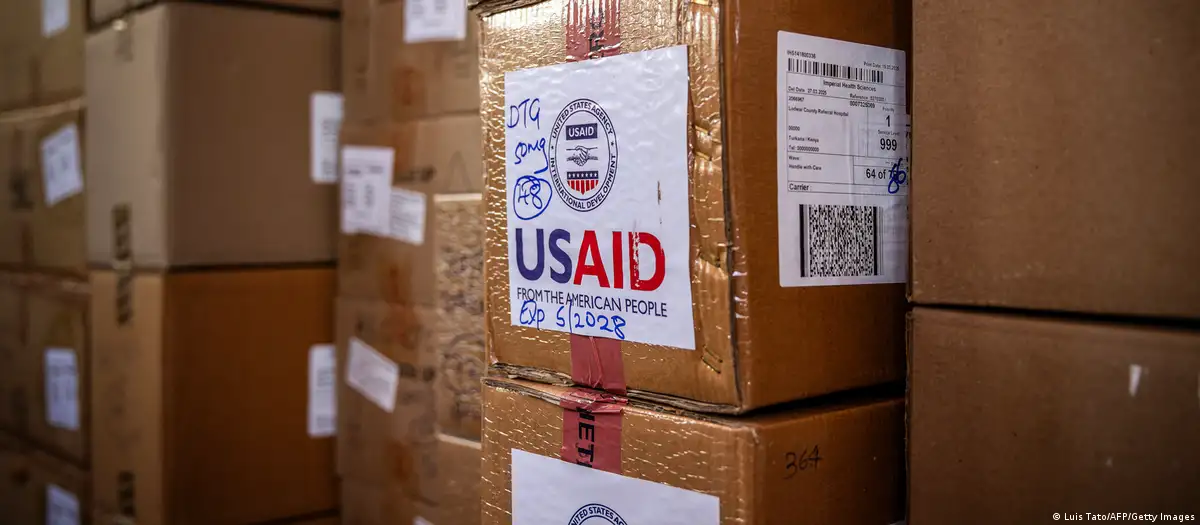
International development aid fell by 23% in real terms in 2025 to the lowest levels since 2015, the Organization for Economic Cooperation and Development (OECD) said on Thursday.
Preliminary data pointed to the largest dip in donations from members and associates of the Development Assistance Committee (DAC) since records began.
For the first time on record, all five of the top international providers reduced their input.
The reduction was spearheaded by the world's richest country, the US, slashing its official development assistance spending by 56.9%, leaving Germany as the world's largest donor by default, even as it missed its own targets for international aid once again.
US now the least generous donor relative to economic clout
Some of the core statistics on official development aid spending from the 34 DAC members and other major countries were as follows:
- Total ODA spending from the 34 members stood at $174.3 billion (roughly €148 billion)
- That equates to just 0.26% of these countries' gross national income (GNI)
- Only four countries — Denmark, Luxembourg, Norway and Sweden — met the UN target of spending 0.7% of GNI on aid
- All five of the top donors — Germany, the US, the UK, Japan and France — reduced their contributions in 2025
- Together, these countries accounted for 95.7% of the overall reduction
- The US alone drove three-quarters of the overall decline as Donald Trump took a hatchet to USAID on his return to the White House
- Washington's 56.9% reduction in aid spending was the largest by any country on record
- This makes the US now the least generous donor as a share of the size of its economy in the entire DAC, donating 0.09% of GNI
- Average donations across members equated to 0.26% of GNI, barely one-third of the UN target
- Other bilateral aid providers outside the DAC — particularly Turkey, the United Arab Emirates and Qatar — are becoming increasingly meaningful donors as European and US input declines
What did the OECD say about the reductions?
"It's deeply concerning to see this huge drop in ODA in 2025, due to dramatic cuts among the very top donors," OECD Secretary-General Mathias Cormann said. "In this challenging environment, the significant decline in official development assistance highlights the need to maximise the impact of available resources, and to use them more effectively to unlock new sources of investment."
Carsten Staur, the chair of the OECD assistance committee told a news briefing on Thursday that "the message is extremely sombre."
The organization also forecasts a further, if more modest, decline of 5.8% in real terms in 2026. It said the atmosphere of sharp and continuing declines presented an "enormous shock to the system."
Germany again misses spending target, but nevertheless becomes largest overall donor amid US cuts
Germany's ODA contributions shrank from 0.68% of GNI in 2024 to 0.56%, at a total of $29.09 billion. If you exclude refugee assistance funding spent inside Germany, that figure falls further to 0.46%, based on Development Ministry figures.
Yet still Germany became the largest overall donor in the world for the first time in history as the US, with an economy roughly six times the size of Germany's, slashed its spending.
The US remains the second largest donor in overall terms, with EU institutions next in line and the UK a fairly distant fourth.
Aid organizations criticized the government in Berlin while security expert Philipp Rotmann at the Global Public Policy Institute said the reductions were "not in Germany's security interests" given the "deadly gap" left by the US pullout, from which Russia and China would seek to profit geopolitically.
"The world's on fire and Germany continues to cut," Oxfam Germany chairwoman Charlotte Becker said, saying the reductions had life-threatening consequences.
Church charities like Brot für die Welt, Misereor, Caritas International and Diakonie issued a joint statement decrying a "dangerous downward spiral" in spending.
Ukraine aid rises thanks to EU input, dominates overall outlay
Net bilateral aid to wartorn Ukraine from DAV members fell by 38.2% last year, according to OECD figures. This was driven by a sharp US dip as Trump returned to the White House, even as 23 countries increased bilateral contributions.
However, because of new support via EU institutions in Brussels rather than member states, overall donations to Ukraine totaled $44.9 billion, an 18.7% increase on 2024 that bucked the overall trend and "the largest volume of net ODA to any single recipient in any year on record," the OECD said.
"This amount was larger than DAC members' combined bilateral ODA to all less developed countries ($28.1 billion) and all countries in sub-Saharan Africa ($29.2 billion)," it said.
The reduction in donations was most sharp in bilateral development assistance, falling 26.4%. Multilateral ODA spending levels fell by 12.7%. The volume of bilateral development grants fell much more sharply (down 29.3%) than bilateral spending on loans (down 10.3%).
Edited by: Alex Berry