Testing times for India-Bangladesh ties amid deepening rifts
December 25, 2025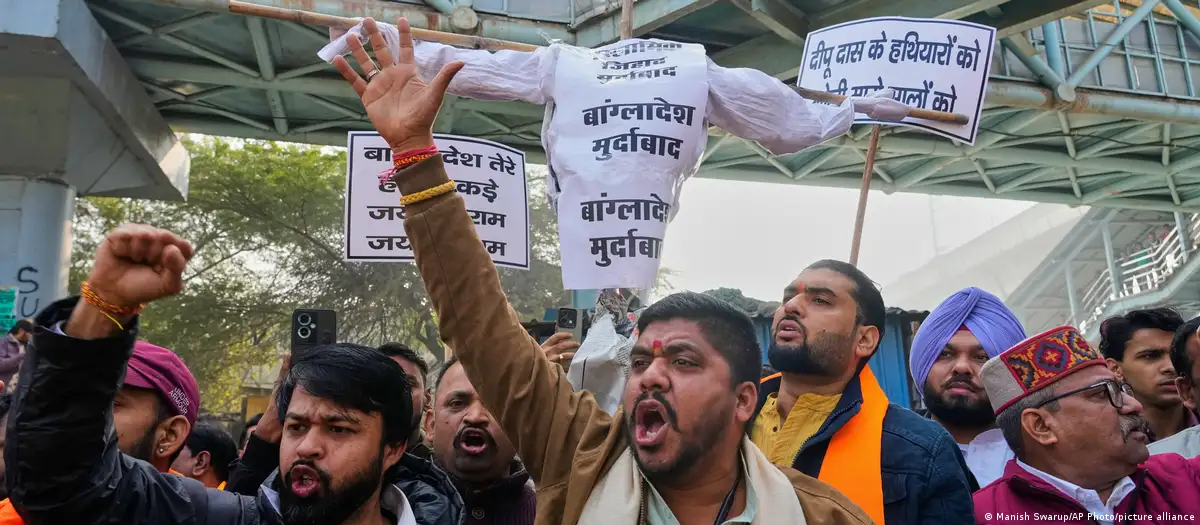
Diplomatic relations between India and Bangladesh have hit a critical juncture with Dhaka suspending visa and consular services at its missions in New Delhi and Agartala on December 22 following protests outside the facilities.
India has also suspended visa services at its Chittagong visa application center in Bangladesh following widespread violent protests triggered by the death of prominent Bangledeshi activist Sharif Osman Hadi.
The 32-year-old was a fierce critic of India and a key figure in the 2024 uprising that ended the 15-year autocratic rule of former Bangladeshi Prime Minister Sheikh Hasina.
Hadi died on December 18 in a Singapore hospital where he was being treated after being shot in the head a week earlier in Dhaka by a masked man riding on the back of a motorbike.
Bangladesh's interim leader Muhammad Yunus has called the shooting a premeditated attack carried out by a powerful network aimed at derailing elections planned for February.
Envoys summoned in tit-for-tat move
Tensions between India and Bangladesh further increased following the killing of Dipu Chandra Das, a 25-year-old Hindu man lynched and burned in public in Bangladesh's Mymensingh district over blasphemy allegations.
Several areas across India, including Kolkata and Hyderabad, witnessed protests by prominent Hindu groups seeking justice for Das. Many carried placards and banners with slogans including "India will not tolerate torture of Hindus in Bangladesh."
New Delhi and Dhaka summoned each other's envoys earlier this week in a tit-for-tat move to express concern over the situation that has escalated into reciprocal suspension of visa services and heightened tensions over minority safety and diplomatic security.
This visa freeze affects tens of thousands of Bangladeshis seeking medical treatment in India, creating a humanitarian dimension.
India has sharply rejected Bangladesh's attempt to equate protests at its facilities in Dhaka with protests outside Bangladeshi missions in India.
"India continues to keep a close watch on the evolving situation in Bangladesh. Our officials remain in touch with Bangladesh authorities and have conveyed to them our strong concerns at the attacks on minorities. We have also urged that the perpetrators of the barbaric killing of Das be brought to justice," said Randhir Jaiswal, spokesperson for India's Foreign Ministry.
The visa suspension represents the most tangible impact on ordinary citizens since tensions flared. India was issuing around 1,500 visas daily to Bangladeshis, prioritizing medical and emergency visas.
The entire pipeline of patients is affected especially for those needing new visas, follow-up appointments and emergency care.
But this is not the first time this kind of thing has happened. Following political unrest and Hasina's ouster in August last year, Indian visa centers across the country were closed indefinitely for security reasons.
'Complex interdependence'
Experts and former diplomats emphasize that the diplomatic breakdown between the neighboring nations was serious given the recent tensions.
"The visa freeze is ad hoc, not permanent," Sanjay Bhardwaj, a professor of South Asian studies at Delhi's Jawaharlal Nehru University, told DW, noting that it is "more of a tactical move rather than a strategic rupture."
"India closed its Chittagong visa office after escalating anti-India rhetoric threatened staff safety. Bangladesh's suspension of visa operations in India is purely retaliatory, designed to appease domestic constituencies," he said.
Bhardwaj said that India and Bangladesh share a complex interdependence.
"Bangladesh cannot function without Indian cooperation — whether in trade, transit, or connectivity," he added.
"This visa standoff, while disruptive for ordinary citizens, does not automatically derail broader bilateral relations or commerce. Both sides understand the stakes. The freeze hurts people, not the relationship's structural foundation."
Medical travel hit by fallout
This latest flashpoint builds on over a year of fraying ties that have deteriorated sharply since Sheikh Hasina's ouster, with India expressing growing alarm over the safety of Hindus and other minorities in Bangladesh while Dhaka has pushed back against what it perceives as interference in its internal affairs.
"India's visa stoppage was a temporary security measure responding to tangible, credible threats against our missions and visa centers. Services have since resumed everywhere except Chittagong where the threat remains real," Pinak Ranjan Chakravarty, a former high commissioner to Bangladesh, told DW.
Chakravarty also believes Bangladesh's response is just retaliation. "They're manufacturing a false equivalence to claim their missions in India face similar dangers. It is a fabricated narrative for domestic consumption, not grounded in comparable security concerns," he said.
"Yes, summoning high commissioners is standard diplomatic protocol for lodging concerns. But there is a difference between legitimate security threats and political posturing," added Chakravarty.
Sreeradha Datta, a Bangladesh expert at the Jindal School of International Affairs, said the current crisis will de-escalate in days, but normal India-Bangladesh relations will not resume until an elected government takes power in Dhaka.
"Fringe elements have hijacked the political narrative — this does not reflect majority Bangladeshi sentiment," Datta told DW.
"The interim government must prove it can control internal violence. What happened with Prothom Alo and Daily Star newspapers exposes either gross incompetence or ill intention, and the authorities have shown little interest in repairing ties with India," added Datta.
On December 18, mobs vandalized, looted, and set fire to the headquarters of the newspaper offices amid riots following the assassination of youth leader Hadi.
"The stalemate is clear. Bangladesh's caretaker administration lacks legitimacy and political will, while India waits for a credible partner. Unless Dhaka signals genuine intent to normalize relations, New Delhi will not budge," said Datta.
What next for India-Bangladesh ties?
Bangladesh's interim government blamed the violence on fringe elements and vowed full justice for the attacks.
A culture of mutual blame at both public and diplomatic levels has deteriorated ties between India and Bangladesh.
Some experts say the relationship is clearly in crisis mode with visa services suspended, envoys being summoned, protests at diplomatic missions, and a breakdown in day-to-day cooperation.
Riva Ganguly Das, a former envoy to Bangladesh, told DW that the latest round of protests leading to visa suspensions has escalated India-Bangladesh tensions to dangerous levels.
She said that given the situation in Bangladesh and the threat to Indian visa offices, closing the office seems the only alternative.
"The security situation in Bangladesh is extremely serious, bordering on lawlessness. For Dhaka to compare protests in India with the violence in Bangladesh is fundamentally disingenuous," said Das.
"Also, the contradictions are glaring," she added.
"Following the killing of youth leader Hadi … police claim his assassins may still be inside the country, while other government officials simultaneously allege they have fled to India," she added.
Despite the current acrimony, experts suggest political stability offers the clearest path out of this crisis.
The stage, said Datta, was set for Bangladesh Nationalist Party (BNP) leader Tarique Rahman's return to the country after 17 years in exile.
"There is a deliberate attempt by certain sections to vitiate and polarize the situation ahead of the February elections. However, Rahman's return could bring a stronger push for stability and keeping elections on schedule," said Datta.
Edited by: Keith Walker