Ice diving for climate research
The ice cover in the polar regions is shrinking. In Lake Kilpisjarvi, Finland, research divers are training under the ice in preparation for Arctic climate expeditions — a race against time.
In the icy waters of Lake Kilpisjarvi
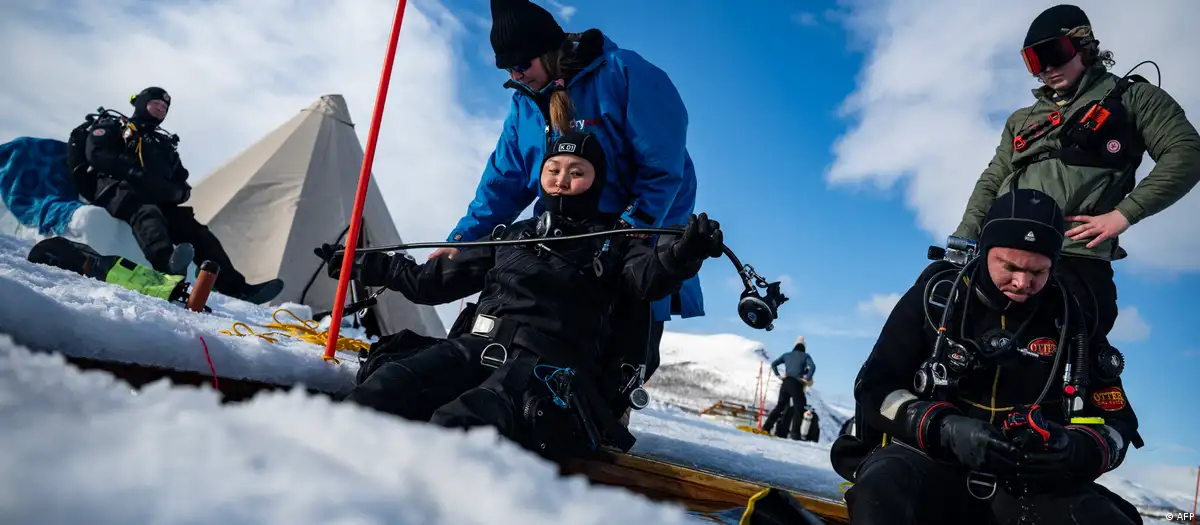
With a firm grip, scientists pull a diver out of a hole in the ice on Lake Kilpisjarvi in Finland. Here, in the border triangle between Finland, Sweden and Norway, 12 researchers from around the world are training for scientific dives under extreme Arctic conditions.
Training in snow and ice
The scientists work at the University of Helsinki’s biological research station at the foot of Mount Saana. Here they find an ideal training ground for diving under the ice. Collecting samples beneath the thick ice is a challenging task; fewer than 200 researchers worldwide are qualified to perform it.
Underwater ice cave
The Arctic is changing rapidly due to global warming. Researchers want to collect samples and data while they still can. For the divers, this means working under extreme conditions: wetsuits protect them from the freezing cold, while a massive layer of ice weighs down on them. "They are entering a kind of underwater ice cave," says Erik Wurz, the program coordinator.
Ice diving is a team effort
Properly working diving equipment is essential for survival. One of the participants carefully inspects an oxygen cylinder and the hoses. Underneath the thick layer of ice, the water temperature's below 5 degrees Celsius (41 degrees Fahrenheit). Without proper training or protective gear, uncontrollable shivering, shortness of breath and circulatory problems can set in after just a few minutes.
Diving and ice drilling
For well-equipped researchers, however, a dive lasts about 45 minutes. One of the exercises involves "ice coring," which requires extracting a core sample from the lake’s thick ice layer. A light at the opening in the ice helps the divers navigate, and a yellow towline guides them safely back to the exit in poor visibility.
Luxury compared to the Arctic
The "Base Alpha" diving station, with its two square openings in the ice for diving, is sparsely equipped — yet comfortable compared to a real polar expedition. Divers train here to be able to act confidently under critical conditions in the Arctic, for example when the luxury of warm buildings and showers is a distant memory, says coordinator Wurz.
Arctic sea ice is melting rapidly
"There's still a lot of questions to be covered in the polar regions and access is very limited," says Wurz. But time is running out: According to the latest US research data, Arctic sea ice coverage this winter was smaller than ever before since records began. If the sea ice disappears, the information stored within it will also be lost forever.
A challenging task with dazzling interludes
Despite the challenging tasks, the divers are still dazzled by their underwater experiences. One participant raved about how the sun pierced through the snow and ice, creating rays of light in the water. Her teammate agrees: "It's like a whole new world, and I would love to explore that."