Germany updates: Berlin vows billions in space defense
Published September 25, 2025last updated September 25, 2025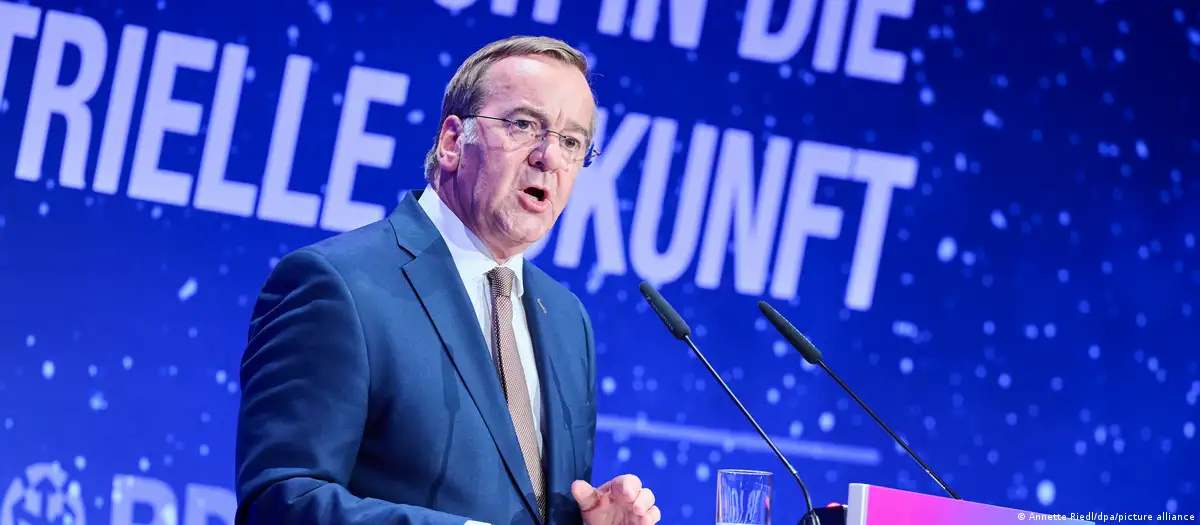
What you need to know
German Defense Minister Boris Pistorius said the country will invest €35 billion ($41 billion) on outer space defense by 2030, to establish a resilient system consisting of satellites, ground stations, secure launch capabilities and related services.
The investments are to guarantee "both protection and effectiveness," to counter Russia and China, which have in recent years rapidly expanded their capabilities for conducting warfare in spaQce.
Meanwhile, Germany's top economists say Chancellor Friedrich Merz’s debt-fueled spending plan will give only a short lift without structural change.
One expert warned that high costs, skills shortages, and heavy bureaucracy are masking deeper weaknesses, while another likened the economy to an addict "junkie" on a temporary fix.
The warning piles pressure on Merz, who has promised an "autumn of reforms" and said the country needed "a new consensus" on how its welfare state should look.
This blog is now closed. Below you can read a roundup of news and analysis on a range of issues connected with Germany from Thursday, September 25:
Germany vows billions in space defense to counter Russia, China
Defense Minister Boris Pistorius said Germany would spend €35 billion ($41 billion) on outer space defense by 2030, citing the threat posed by Russia and its ally China.
"We are strengthening our systems against disruptions and attacks," Pistorius said, explicitly pointing to "cybersecurity for all space systems."
Pistorius said the goal is to establish a resilient system consisting of satellites, ground stations, secure launch capabilities and related services. The investments are to guarantee "both protection and effectiveness."
"Russia and China have in recent years rapidly expanded their capabilities for conducting warfare in space," the German defense minister said. "They can disrupt, jam, manipulate or even physically destroy satellites."
Pistorius pointed out that two IntelSat satellites used by the German military are currently being shadowed by Russian reconnaissance satellites, while China is carrying out highly agile proximity manoeuvres that could be likened to aerial combat exercises in space.
Satellite networks, he cautioned, are an Achilles' heel of modern societies: "Anyone who attacks them can paralyze entire states."
Industry groups argue that Germany has fallen significantly behind other spacefaring nations.
According to a study by the Federation of German Industries (BDI) and consultancy group Roland Berger found Germany's gap with the US and China has widened in recent years, with far-reaching consequences for German industry as a whole.
Bavaria's Söder says Airbus can build fighter jet without France
Bavarian state premier and head of the CSU coalition party, Markus Söder, said Airbus can still build a new fighter jet if France drops out of the troubled Future Combat Air System (FCAS) fighter project.
"Either it goes ahead with our French partner or one has to think about alternatives," Söder said.
"By the end of the year we need a clear line, a decision. Airbus would be in a position to deliver," he added.
Söder's remarks come after the French partner Dassault Aviation said was in a position to develop the jet fighter alone should negotiations with Germany and Spain fail.
"I don't mind if the Germans are complaining. If they want to do it on their own, let them do it on their own," Dassault chief Eric Trappier said at a factory opening event on Tuesday.
"Here, we know how to do it," Trappier added at the time. "We know how to do everything from A to Z. We have proven this over the past 70 years. We have the skills."
The FCAS program was launched in 2017 to replace France's Rafale jet and the Eurofighter planes used by Germany and Spain.
The scheme was jointly developed by France, Germany and Spain, but it has stalled over disagreements between Dassault and Airbus over project leadership and how to divide up production.
It is estimated that the new jet, scheduled to be operational in 2040, will cost €100 billion ($118 billion) to develop.
French President Emmanuel Macron and German Chancellor Friedrich Merz have sought to support the political partnership, but tensions between the two aerospace contractors have marred cooperation.
Hamburg hosts NATO logistics drill 'Red Storm Bravo'
A three-day military exercise called "Red Storm Bravo" has begun in Hamburg.
The drill runs through Saturday and focuses on moving troops through the city's port and onward to eastern NATO territory in a simulated crisis.
About 500 soldiers are taking part alongside police, firefighters, agencies and private companies to test civil-military coordination. The scenario envisions the rapid deployment of forces to the Baltic region in response to an escalating conflict.
"In a NATO contingency on the alliance's eastern flank, Germany becomes the central European hub for moving troops and equipment," said Captain Kurt Leonards, head of the Bundeswehr's Hamburg command.
Exercises will take place mainly at night in the port and include a simulated mass-casualty event. A convoy of military vehicles is scheduled to pass through the city overnight from Thursday to Friday. Officials said the drill is planned to minimize disruption, though residents should expect nighttime aircraft noise and some traffic delays.
Economists warn German growth plan needs structural reforms
Germany's leading economic institutes have said the government's investment package will deliver only short-term gains unless paired with structural reforms.
In their autumn report, the five institutes forecast economic growth of 1.3% in 2026 and 1.4% in 2027. But they cautioned that "persistent structural weaknesses" mean the momentum will not last, according to Geraldine Dany-Knedlik of the German Institute for Economic Research (DIW Berlin).
For 2025, the economists expect GDP to rise just 0.2%, "barely more than stagnating," Dany-Knedlik said, noting the slight upgrade from a 0.1% spring forecast reflecting revised data from previous years.
"A renewal of the German economy remains elusive and prospects for growth are continuing to deteriorate," said Dany-Knedlik, as she presented updated growth projections conducted jointly by several institutes.
"Structural problems are merely being masked," she said, warning that high costs, a gap in skills and diminishing competitiveness all threatened growth.
The report flagged "considerable risks" for the economy, citing the potential for a US trade dispute to escalate and uncertainty over the overall impact of expansive fiscal policy.
The institutes warned that aggressive US trade policy threatened to drag down global growth.
"The US tariff policy casts long shadows over the world economy in autumn 2025," said economist Hannah Seidl of DIW Berlin, noting that while many countries and the EU have reached trade agreements with Washington, those deals "entrench a high tariff level."
Speaking alongside Dany-Knedlik, Stefan Kooths of the Kiel Institute for the World Economy compared the German economy to a drug addict who had just received a fix in the form of Merz's promised billions.
The effective tariff rate on US imports is now more than 10 percentage points above its 2024 level, she said.
This year's joint diagnosis involved DIW Berlin, the Leibniz institutes in Essen and Halle, the Munich-based Ifo Institute and the Kiel Institute for the World Economy.
Far-right AfD surges to 38% in eastern state poll
A year before a state election in the northeastern state of Mecklenburg-Western Pomerania, the Alternative for Germany (AfD) leads with 38%.
The figure is double that of the governing center-left Social Democratic Party (SPD) at 19%, according to an Infratest dimap poll released Thursday for public broadcaster NDR.
The conservative Christian Democratic Union (CDU) stands at 13%, narrowly ahead of the socialist Left Party (Die Linke) at 12%.
The Greens are at 5% and risk missing the threshold to reenter the state parliament, which sits in the city of Schwerin. The new populist left-wing Sahra Wagenknecht Alliance (BSW) garnered 7%.
The business-focused Free Democratic Party (FDP) fell below the figure deemed statistically reliable and would fail to win any seats.
In the 2021 state election, the SPD won 39.6%, followed by the AfD at 16.7%, the CDU at 13.3%, the Left at 9.9%, the Greens at 6.3% and the FDP at 5.8%. Premier Manuela Schwesig formed a coalition with the Left after that vote.
The survey shows that the current SPD-Left coalition now commands less support combined than the AfD alone.
All other parties rule out partnering with the AfD, while a three-party coalition excluding it is arithmetically impossible. Four-party alliances appear politically unlikely, as they would require the CDU or BSW to work with the Left.
The Mecklenburg-Western Pomerania election is set for September 20, 2026, alongside the Berlin state vote. Three other state elections are scheduled earlier next year: Baden-Württemberg on March 8, Rhineland-Palatinate on March 22 and Saxony-Anhalt on September 6.
Merz visits eastern leaders seeking to counter far-right surge
Chancellor Friedrich Merz is meeting the premiers of Germany’s eastern states as the far-right Alternative for Germany (AfD) gains support ahead of next year’s 35th anniversary of reunification.
Merz’s center-right Christian Democrats once promised "flourishing landscapes" to easterners after the 1989 fall of the Berlin Wall.
However, decades of deindustrialization, job losses and outward migration have fueled AfD's rise. The party is now leading polls in all five eastern states after finishing second nationally in February's elections.
Political scientist Benjamin Höhne of Chemnitz University said the AfD "continues to gain ground in the east" and Merz's efforts to counter it are not working. In Saxony-Anhalt, where regional elections are set for September 2026, AfD polling around 39% could make it the first state led by the party.
Hans Vorländer of Dresden University said many eastern Germans still feel like "second-class citizens."
Since taking office in May, Merz has previously visited the former East Germany outside Berlin only twice, both times to military sites.
German weapons export approvals to Israel drop to zero
The restrictions on arms exports to Israel imposed by Chancellor Friedrich Merz in August have led to a complete halt in the approval of deliveries from Germany during the first five weeks afterward.
This comes from an Economy Ministry reply to a query by Left Party lawmaker Ulrich Thoden, obtained by the German news agency DPA.
Between August 8 — the day of Merz's decision — and September 12, "no approvals" were granted.
In the letter, State Secretary Thomas Steffen said the government decided "on a case-by-case basis and in light of the respective situation after careful review, taking foreign and security policy considerations as well as legal requirements into account."
He added that Germany "reaffirms the principles of its Israel policy and remains particularly committed to the protection of the State of Israel."
On August 8, Merz announced that, for the time being, no exports of military goods to Israel that could be used in the Gaza war would be approved. He was responding to the actions of the Israeli armed forces in the Gaza Strip, marking a course correction in German policy toward Israel.
Up to that point, the German government had gradually increased its criticism of Prime Minister Benjamin Netanyahu's government over its treatment of Palestinians but had refrained from imposing sanctions.
German-made Sa'ar corvettes, small warships with sophisticated radar equipment and cannons, have reportedly shelled targets in Gaza during the war.
Germany had rapidly increased its share of the Israeli weapons market, mostly with naval equipment like ships, submarines and torpedoes.
Bundestag to vote on top court nominees after coalition dispute
German lawmakers are to vote on three nominees to the country's Constitutional Court after a coalition row forced the withdrawal of an earlier candidate.
The Bundestag, Germany’s lower legislative house, will decide whether to appoint law professor Ann-Kathrin Kaufhold, Federal Administrative Court Judge Sigrid Emmenegger and Federal Labor Court Presiding Judge Günter Spinner to the country's highest court.
For a spot on the Constitutional Court bench, each nominee needs at least two-thirds of ballots cast and a majority of all 630 Bundestag lawmakers to be present.
Judges are traditionally put forth by the government, in this case, Chancellor Friedrich Merz's conservatives and their center-left Social Democrat (SPD) coalition partner. In July, the vote on the SPD's original pick, law professor Frauke Brosius-Gersdorf, was delayed after conservatives objected to her perceived stance on various issues, including abortion rights. Brosius-Gersdorf later withdrew.
SPD leaders put forward Emmenegger as the new candidate, and conservative parliamentary leader Jens Spahn says there is "much support," though opposition votes will still be needed.
Constitutional Court judges serve 12-year terms and cannot be reelected. Half are chosen by the Bundestag and half by the upper house, the Bundesrat.
Welcome to our coverage
Guten Tag from the DW newsroom in Bonn.
You join us as it emerges Germany has not approved any new weapons shipments to Israel since Chancellor Friedrich Merz ordered restrictions last month.
An Economy Ministry letter says decisions are being reviewed case by case, citing legal and security concerns.
The government insists it remains committed to Israel's protection despite the pause in approvals.
Meanwhile, Merz is meeting state premiers in eastern Germany in the hope of countering the rise of the far-right Alternative for Germany.
Stay tuned for more throughout the day!