'Cockroach' movement gives voice to India's angry youth
June 2, 2026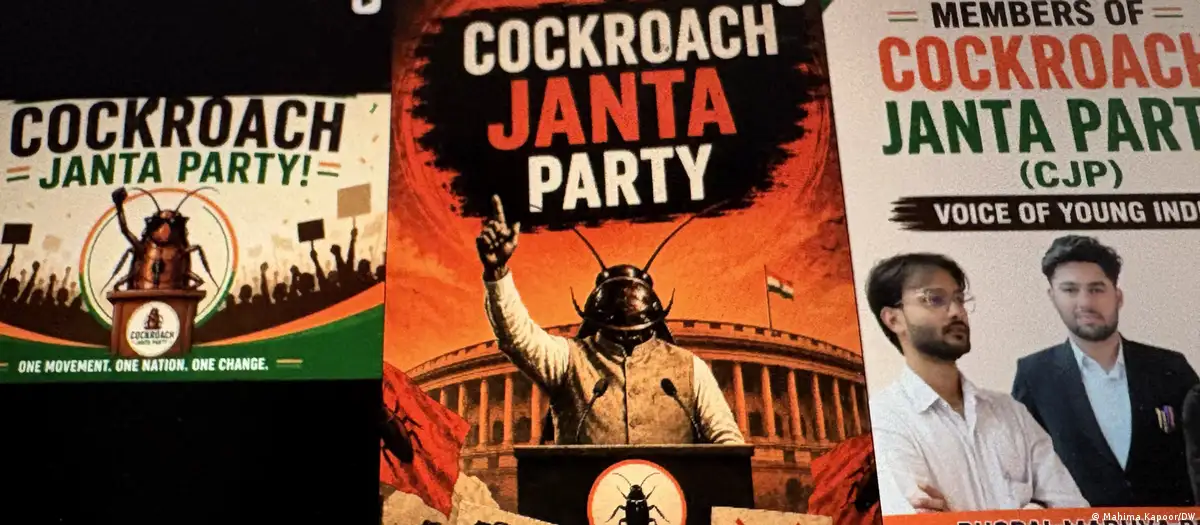
The Cockroach Janta Party (CJP), a movement that emerged from social media satire only weeks ago, is preparing to take its campaign onto India's streets.
Its founder Abhijeet Dipke, a 30-year-old Boston University graduate, said on Monday that he would return to India to lead a "peaceful protest" on June 6 demanding the resignation of Education Minister Dharmendra Pradhan over alleged exam irregularities.
"The time has come for all of us to come together, following the path of the Constitution of India, and peacefully raise our voices to demand Dharmendra Pradhan's resignation," Dipke said in a video posted on the CJP's Instagram handle on Monday. "If we raise our voices together, they will definitely have to listen to us," he added.
India's nationwide medical entrance test was canceled last month, but only after some 2.2 million students had already taken the exam. The authorities said the move was due to suspicions that exam questions had been leaked.
'Cockroach' movement inspired by India's chief justice
The CJP was set up after remarks attributed to Chief Justice of India Surya Kant, who reportedly compared some unemployed young people to "cockroaches" and "parasites."
Kant later said his comments were taken out of context and that he was referring to those who use fake degrees.
But the remarks touched a raw nerve among many young Indians already struggling with unemployment, recurring examination scandals and growing economic insecurity.
Though Dipke launched the CJP as a satirical online project, it quickly took on a life of its own.
"There is this underlying feeling among [India's youth] that the current political system just does not care about them, be it the government party or the opposition," Dipke told The New York Times in a recent interview.
Combining humor with political criticism
According to statements on the CJP website and social media platforms, the new group aims to create local chapters, recruit volunteers and campaign on issues ranging from joblessness and exam paper leaks to educational reform and government accountability.
Since its launch, the CJP has established an immense social media following.
Its Instagram handle now has over 22 million followers — far more than the ruling Bharatiya Janata Party's (BJP) which has 9.5 million, and the main opposition Congress Party, with its 13.9 million.
Authorities have blocked the group's X account, however, citing national security concerns.This has prompted a legal challenge.
Some Indian leaders have alleged that the CJP is backed by India's enemies abroad.
Rajeev Chandrasekhar, a senior politician from Prime Minister Narendra Modi's Bharatiya Janata Party (BJP), described the movement as a "cross-border influence operation" aimed at destabilizing India.
While enior Cabinet minister Kiren Rijiju accused the CJP of seeking social media followers from arch-enemy Pakistan and the "anti-India gang."
Meanwhile, Dipke — who has lived in the US for the past two years — has alleged surveillance and intimidation against the CJP.
He said his family and friends were worried he could be arrested on his return.
'A widening disconnect'
Sociologist Avijit PathakIt told DW that it was too early to say what the CJP could realistically achieve. The more important question, he argued, was what the movement says about Indian society.
"Whether it survives is impossible to predict," Pathak told DW. "But it already reveals a widening disconnect between citizens and an establishment that appears increasingly unwilling to listen."
The movement, he added, has simply tapped into anxieties that were already present.
Pathak also sees a deeper lesson in the movement's use of humor.
"Humor is never as innocent as it appears," he said. "Throughout history, satire has served as a powerful instrument of political critique."
The rise of digital dissent
For Pathak, what unsettles those in power is not necessarily organized opposition but the ability of jokes, memes and collective mockery to puncture images of authority.
The movement's meteoric rise also reflects broader global trends in articulating political dissent.
The CJP relies on digital participation, viral communication and decentralized organization rather than traditional political machinery. Its supporters communicate through memes, videos and social media campaigns rather than party offices and formal hierarchies.
However, the CJP's success cannot be explained by social media alone.
Reclaiming the insult
For media critic and press ombudsperson Pamela Philipose, the movement's breakthrough has come from its ability to transform a symbol of humiliation into one of visibility.
"What is remarkable is how a term used to belittle unemployed youth has been appropriated and turned into a badge of resistance," Philipose told DW.
More importantly, she argued, is that the CJP succeeded in directing public attention toward issues that had long existed beneath the surface in India's society.
"What it has done is give them a language and a symbol," she said.
Can online support turn into political power?
CJP organizers have encouraged supporters to establish local networks, hold youth meetings and launch campaigns.
The transition from internet phenomenon to political organization, however,could be difficult.
Registering as a political party in India requires organizational structures, financial transparency and sustained grassroots support.
The CJP also faces other practical challenges before it can enter the official political arena. Election regulations impose strict requirements on political parties and may prevent the movement from using its signature cockroach imagery as an official election symbol.
"Social media following and an electoral mandate are two different matters. That is important to know," BJP spokesperson Tom Vadakkan told DW.
Ordinary people left behind by media, politicians
"The CJP is doing what satire has always done, speaking truth to power," political satirist Sanjay Rajoura told DW.
"When the space for dissent shrinks, alternative forms of expression inevitably emerge," he said.
Rajoura also believes the movement has benefited from frustrations with sections of the mainstream media, which critics accuse of focusing excessively on political elites while paying insufficient attention to everyday concerns such as unemployment and educational failures.
In that environment, a satirical movement can become something more consequential than entertainment, experts say.
While the CJP transformation into a viable political force remains in question, the youth movement has already left its mark by transforming a joke into a national conversation.
Edited by: Srinivas Mazumdaru