China launches youngest astronaut and 'space mice'
October 31, 2025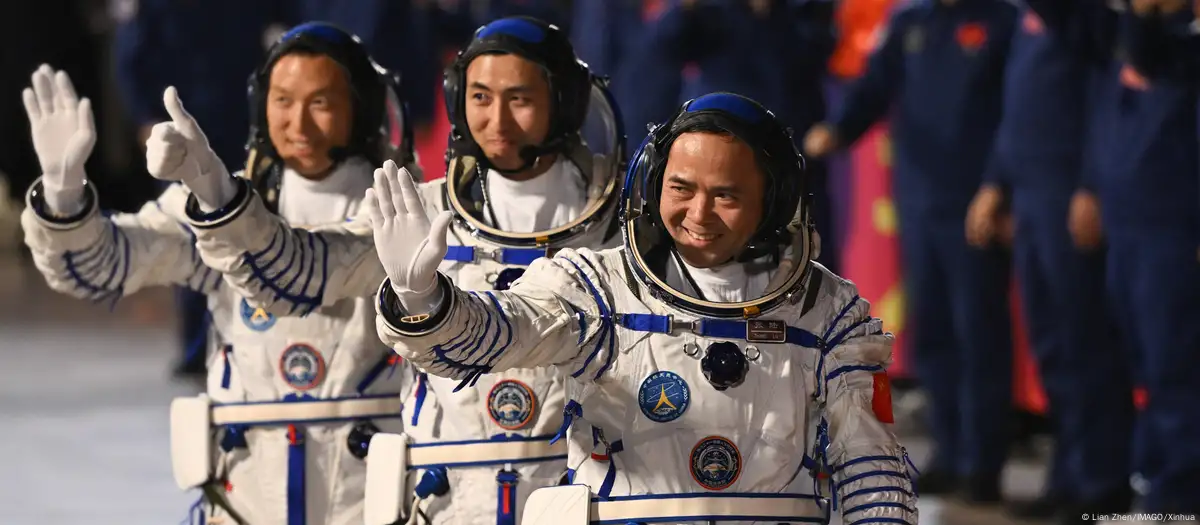
China's Shenzhou-21 spaceship launched Friday, carrying its youngest astronaut and small mammals to the country's orbiting space station.
The Tiangong space station, crewed by rotating teams of three astronauts, is the centerpiece of China's multibillion-dollar space program.
Beijing aims to send astronauts to the moon by the decade's end and eventually build a lunar base, in a bid to rival the US and Russian space programs.
Mice and men, to space
The latest crew to Tiangong consists of first-time astronauts Zhang Hongzhang and Wu Fei, who, at 32, is China's youngest astronaut to be sent to space. They are led by Commander Zhang Lu, who spent time in space two years ago.
Also onboard the spacecraft are four mice, the first time China is sending the small mammals to the space station.
They will be monitored to study how weightlessness and confinement affect their behavioral patterns.
The "space mice" were selected from 300 candidates after more than 60 days of intensive training, according to China's official Xinhua News Agency.
The astronauts plan to conduct 27 experiments in fields such as biotechnology, space medicine and materials science.
US-China space race
The launch comes as China is planning a crewed mission to the moon by the end of the decade.
"Our fixed goal of China landing a person on the moon by 2030 is firm," said Zhang Jingbo, a spokesperson for the China Manned Space Agency.
Built entirely by China after its exclusion from the International Space Station, the Tiangong space station has positioned Beijing as a major space power.
This week, SpaceX said it pitched NASA a "simplified" plan to return US astronauts to the moon before China can complete its manned lunar mission.
Edited by: Sean Sinico