Sea meets school in Senegal's Black Girls Surf project
In the fishing district of Ngor, near Dakar, a surfing academy combines school education with catching waves. The Black Girls Surf project encourages young women to stay in school and opens doors for their future.
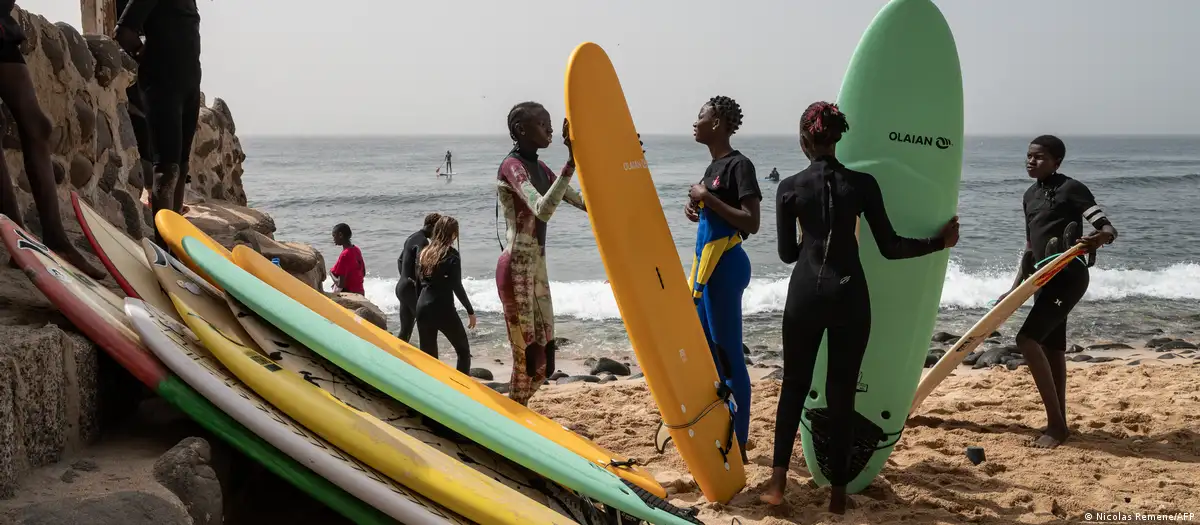
Back to school with surfing
Seynabou Tall's ancestors have been fishing, diving and rowing off the coast of Dakar for generations. Now, the 14-year-old is learning to surf there after dropping out of school almost four years ago. She and about 20 other girls are participating in a newly founded surfing academy, for which they had to register in a school building. Their motivation: to ride the waves.
From the waves to the classroom
Twenty-three girls aged 7 to 17 took part in the first academy in Dakar. Seventeen of them had never been to school or had dropped out. They are given surfboards and wetsuits and spend their days doing fitness training, meditation and surfing. In the evenings, they receive lessons as part of an educational program.
A village closely connected to the sea
The Corniche, in the Almadies district, is one of the most famous surfing spots on Dakar's Atlantic coast. Just a few kilometers away is Xataxely, a small fishing village in the Ngor district, where almost all of the young women come from. The area is home to the Lébou, a fishing people with close ties to the sea. The houses are often just a few meters from the beach.
Senegal's popular surfing spot
The capital's year-round first-class waves enrich the lives of young female surfers and also attract surfers from all over the world. The academy's participants often train on the famous Ngor Right, a world-renowned right-breaking wave.
A professional surfer fights for change
Khadjou Sambe (right), Senegal's first professional surfer, is herself a Lébou from Xataxely. She is the vice president of the Dakar chapter of Black Girls Surf, which launched the four-month surf academy. The US-based organization aims to attract more Black women to surfing, a sport traditionally dominated by white men.
Catching up on schoolwork with focus
The official sporting part of the program ran until the end of January, but in-school lessons will continue until July. The lack of primary education among aspiring female surfers is not uncommon in Senegal: According to the UNESCO Institute for Capacity Building in Africa, the primary school completion rate in 2022 was only 60% for girls and 55% for boys.
First academy shows results
The participants have received their first grades and most of them have achieved very good results. The success of the first academy impressively demonstrates how sport, targeted support and mentoring empower young women, not only on the water but also in the classroom, promoting their academic, personal and athletic development in the long term.