India's digital census prompts fear of hidden agendas
April 8, 2026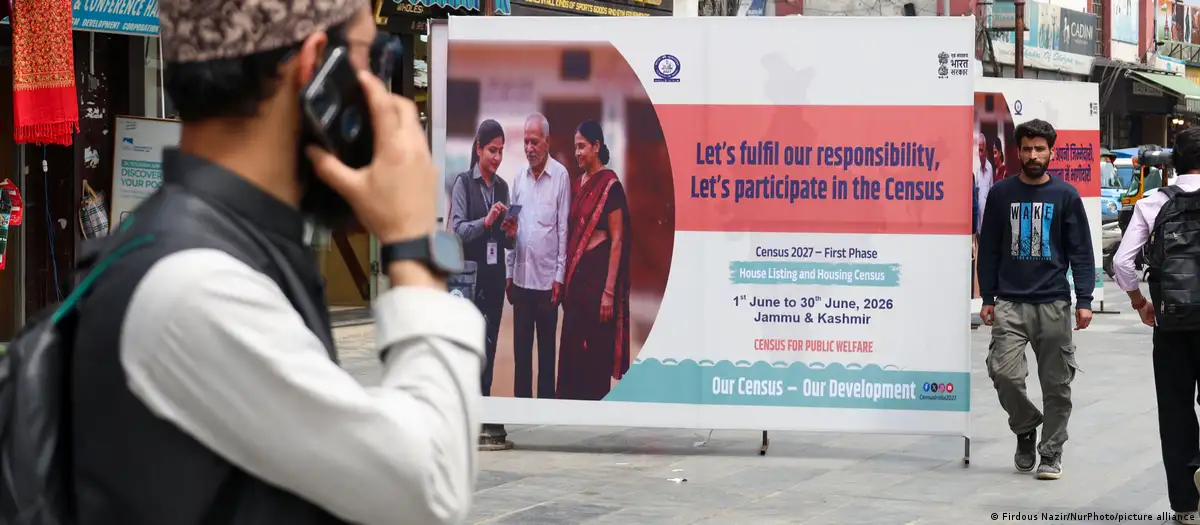
India has been conducting a fully digital census since April 1, deploying over 3 million enumerators while also providing people with an opportunity to enter their data into a self-enumeration portal.
In the first phase, the officials will focus on house listing and housing conditions. This involves collecting data on 33 parameters, including building materials, access to basic amenities like electricity and clean water, and ownership of assets such as smartphones and vehicles.
Every building will also be geo-tagged to ensure complete geographic coverage and an accurate reflection of the country's infrastructure.
The second phase, scheduled for early next year, is to focus on the population, gathering detailed demographic and socio-economic data. This includes recording age, education, and occupation for every individual. By capturing migration patterns and fertility data digitally, the officials hope to form a comprehensive profile of India's evolving population, which is already considered the largest in the world.
Most notably, however, the census will include a comprehensive enumeration of castes across all communities, the first such exercise since 1931.
Fears of hidden agendas lurking behind India's census
Between April 1 and April 15, Indian citizens have the option to report all the vital data themselves.
"The self-enumeration exercise is a secure, web-based facility available in 16 regional languages. For the first time, respondents can fill in their details online at their convenience before the enumerator's visit," said a government statement.
"The census remains a vital tool for governance, providing foundation for India's development planning for the next decade," it added.
But for the people with little experience with technology — most of whom live in rural parts of the country — the online portal might prove to be too much of an obstacle. Their data would still need to be gathered by census takers, but that process also comes with its own set of challenges.
Even before the census was launched, critics questioned if the enumerators will actually be given the time and training to handle the vast number of households that need to be processed. Some also fear that households may be encouraged to self-enumerate without adequate support, or relay their data through informal intermediaries.
Most importantly, critics are concerned that the data may be skewed for political manipulation. The results, expected in 2027, will feed into some of the most politically sensitive decisions India faces, from caste enumeration to the eventual redrawing of parliamentary constituencies.
A matter of trust
The last census was conducted in 2011. While fraudulent enumerator or a manipulated local tally was always possible, proponents of the old way of data gathering argue the damage was more likely to be limited, and that data was recorded on paper and took more time to process.
Today, with India shifting from paper to digital, the data will flow into central systems almost instantly. This census also gathers more sensitive information than before such as caste, religion, economic status, and migration thus raising the stakes further, especially if such data were ever to be cross-referenced with other national databases.
"The risks are not new, but digitization changes their scale. What was once local and contained can now become systemic if safeguards fail," S Y Quraishi, former chief election commissioner, told DW.
"The shift to digital matters but the real issue is credibility, not technology," Quraishi added. He pointed to the "high political stakes" such as delimitation — the process of determining the number representatives for a given state or a constituency — and gender quotas.
The census' success "will depend less on apps and more on transparency, audits, and whether it is seen as fair and inclusive," he told DW.
Quraishi warns that caste enumeration could reshape quotas and trigger tensions, while delimitation of constituencies risks deepening a North–South fault line over political representation in the country.
"Add privacy concerns and fears of data misuse, and the real test becomes ensuring trust, federal balance, and political acceptance, not just execution," he added.
Lack of internet experience raises risk of fraud
"The issue is less about digitization itself and more about whether robust safeguards, transparency, and accountability frameworks are in place to ensure the integrity and security of the data," Reetika Khera, an economist from Delhi's Indian Institute of Technology, told DW.
Khera's previous research examined how India's national biometric identity system shapes privacy rights and the delivery of social welfare to its poorest citizens.
Drawing on recent government survey data, Khera notes that digital preparedness is poor.
"For instance, less than half of rural women (above 15 years of age) own mobile phones. Though many can use payment apps, very few are comfortable with other online tasks as less than 1% said they could do net banking," Khera told DW.
This, Khera states, raises questions about who can realistically participate in self-enumeration.
She flags the risk of intermediaries stepping in, as seen in other schemes that required digital participation, where middlemen have sometimes enabled fraud.
"If such actors begin offering 'self-enumeration services,' they could become a weak link despite legal safeguards under the Census Act," she added.
A new era of Indian politics?
The risks go beyond access and the issues of data security and accountability. India's shift to a digital census is not merely a technical upgrade but a structural change in how the state counts and engages with its population.
"The shift to a digital format, while potentially improving efficiency, also raises the possibility that data could be processed and operationalized faster, with limited public scrutiny, shaping the timeline for a future delimitation exercise," Yamini Aiyar, currently a visiting senior fellow at Brown University, told DW.
"The prolonged delay since 2021 because of the pandemic, combined with the push to have results ready by 2027, has not been fully explained, leaving room for questions about intent and sequencing," she said.
In Aiyar's reading, the issue is not that such an outcome is predetermined, but that the opacity around timing, process and data use risks deepening existing political anxieties around how the census will ultimately shape India's electoral map.
"This unease is particularly pronounced in southern states, where there is apprehension that delimitation based on updated population data could tilt political representation toward the north, altering the federal balance," she adds.
Scale of Indian census poses unprecedented challenge
Dipa Sinha, a development economist specializing in economic and social policy, points out that while this is the first fully digital census, India is not new to digital data collection.
Surveys like the National Sample Survey (NSS), the country's long-running, large-scale household survey system that collects socio-economic data for policy and planning, have used similar methods before.
"So, in principle, the shift is not problematic. However, the scale is unprecedented, coming after a long delay, which raises fresh concerns," Sinha told DW.
Sinha said it is not clear what mechanisms are in place for data protection, privacy, and correction of errors in such a large, technology-driven exercise.
"In a census that collects highly sensitive personal information, the absence of clearly articulated protocols risks undermining confidence," she added.
Edited by: Darko Janjevic