Germany's finance minister rejects money misuse accusations
March 21, 2026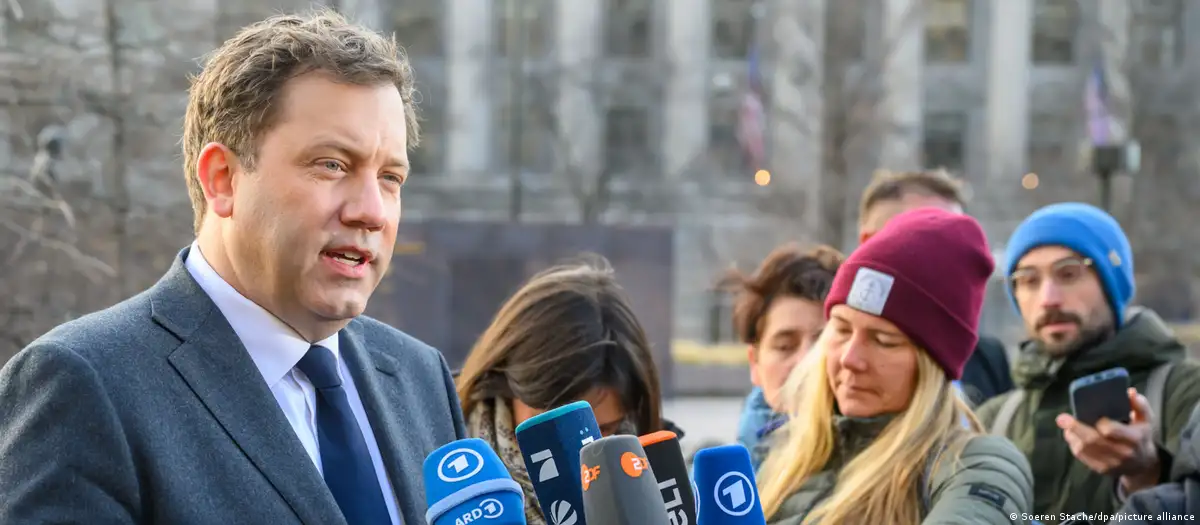
Lars Klingbeil, the finance minister from the center-left Social Democratic Party (SPD), who likes to call himself the "Minister of Investment," has more money at his disposal than any of his predecessors before him. In 2025, the Bundestag approved a special fund for infrastructure and climate neutrality, allowing €500 billion ($579 million) in additional debt.
One year later, two economic research institutes have now published negative progress reports, and the accusations leveled at the German finance minister are serious. According to calculations by the Ifo Institute in Munich and the German Economic Institute in Cologne, instead of allocating money from the special fund to new investments, Klingbeil is using it to fill budget gaps.
Klingbeil has denied accusations that the federal government has misused vast amounts of funding. He claims the loans from the special debt fund were spent exclusively on infrastructure — as required by law. The finance minister maintains that the key issue is ensuring the released funds reach local communities.
"What matters is that swimming pools are being renovated, that bridges are being repaired, that high-speed internet is being installed. That is what matters most right now. And that is what we at the Finance Ministry will continue to work toward," Klingbeil said this week in Berlin.
'Funds misappropriated'
Clemens Fuest, head of the Ifo Institute for Economic Research, had warned of the potential negative consequences for fiscal policy a year ago, when the Bundestag approved the historically unprecedented credit package.
Following the release of his latest study this week, Fuest reiterated his criticism, stating that 95% of the funds have been misappropriated to balance the 2025 budget.
"In light of the current situation, indirect financing of such expenditures or tax cuts through debt is clearly not appropriate," said Fuest in an interview with public broadcaster ARD. "What we need is not the distribution of handouts and favors, including some justified grants and subsidies, but rather cuts to non-priority spending. The coalition is headed in the exact opposite direction."
Have legal requirements been met?
Senior officials at the Finance Ministry have criticized the economic institutes for comparing apples to oranges in their reports — that is, for making inappropriate comparisons between the old 2024 budget plan and the new 2025 plan.
According to the ministry, investments from the federal budget and additional investments from the special fund totaled €87 billion last year. The ministry said this represents a 17% increase compared to 2024, thereby fulfilling the legally mandated investment target of 10% in the federal budget, also known as the core budget.
Experts at economic research institutes interpret the figures differently and have accused the finance minister of using €23 billion from the special fund to finance investments that were previously earmarked in the core budget.
This constitutes an accounting sleight of hand — according to the economic researchers but also the opposition in the Bundestag, the lower house of parliament. The environmentalist Greens and the far-right Alternative for Germany have threatened to file lawsuits with the Federal Constitutional Court.
The special fund is intended to last for 12 years. Federal investments are projected to total €128 billion in 2026, with €58 billion coming from the special fund. Spending is expected to remain at a similar level each year until 2029. From 2030 to 2036, only about €20 billion per year can then be drawn from the debt-financed special fund. Starting in 2037, all investments must again come from the regular budget.
Economic researchers and budget policymakers in the Bundestag will continue to monitor the situation closely. According to a commentator from the business newspaper Handelsblatt, however, one thing is already clear: "The entire narrative of the 'investment minister' that Klingbeil has crafted for this legislative term has not worked out so far. Instead, he comes across as the 'minister of reallocation.'"
This article was originally written in German.
While you're here: Every Tuesday, DW editors round up what is happening in German politics and society. You can sign up here for the weekly email newsletter, Berlin Briefing.