Architecture for the people
How do we want to live? Pritzker Prize-winner Alejandro Aravena poses one of the biggest questions in life while working tirelessly to bring people and the environment together in his daring social housing projects.
Concrete facade
The Innovation Center is located on the campus of the Catholic University in Santiago de Chile. A 14-floor tall cement monolith, the building adapts to the climate. Its facade shields those inside the building against sunlight and heat. On the outside the structure looks opaque and monumental.
Light and airy
But on the inside, the building is flooded with light. Natural airflow through the building also reduces energy costs, while the open design promotes communication and exchange. Because, where there is innovation, people must talk to each other, says Aravena.
Half-finished houses
This is the project that made Alejandro Aravena world famous: in 2004, he built social housing for a hundred families in Chile, paid for through public funding. The architect was of the opinion that the money would not be enough to build big houses, so he built half-finished houses. Residents were then able to build the other halves on their own terms.
Housing for everyone
Over the years, Aravena managed to build more than 2,500 housing units for the poor - for the most part in Chile, but also in Mexico and Brazil. He became known as the "architecture activist". Aravena talks to people, involving them in the planning and construction phases - and he takes on one of the most important questions in urban planning: How can cities make affordable housing available?
The anti-star architect
Aravena's social housing units are a world away from the star-architect's iconic building ideas. But that's exactly what Alejandro Aravena does not want to be: a star, who builds luxury temples and loses touch with humanity. Aravena combines social responsibility with economic constraints and human design, according to the Pritzker Prize jury.
Aravena's playground
The Pritzker Prize jurors commended his interest in improving urban spaces with projects like this: a children's playground built in Santiago de Chile's city park that measures almost 2,000 square Kilometers.
The Siamese Towers
Even though Aravena rejects outrageous ideas - in the way that many other contemporary architects prescribe to - he proves that can also design iconic structures, such as his "Siamese Towers". The glass facades are actually completely unsuitable for Santiago de Chile's hot climate; they result in the building's overheating. But the architect insisted on having the glass facades for a reason...
A building within a building
Aravena ingeniously constructed another building inside the glass facade - fulfilling with energy-efficient criteria. Vertical winds in the space between the two constructions provide additional cooling. The towers stand together with others of Aravena's buildings on the grounds of the Catholic University in Santiago.
A barren exterior
Aravena's design for the student residence at St Edward's University in Austin, Texas, has to assert itself in a harsh, uncompromising environment. The outer shell of the building looks archaic and somewhat forbidding, but that's just a mere facade.
Colorful interior
The student halls' inner courtyard is, however, open and colorful. Every room allows for natural light to flood the interiors. The residence can accommodate 300 students and provides social spaces and meeting points with the odd inviting game of table tennis - what else would we expect from Aravena?
Ocean panorama
In 2014, Alejandro Aravena built five lookout points on Chile's Atlantic coast. Here, his architecture qualifies as almost sculptural. The project was part of coastal strip's restoration following the destruction caused by the tsunami. The material used is wood. These geometrically arranged buildings stand in stark contrast to the rugged landscape, lending further emphasis to their design.
Aging with time
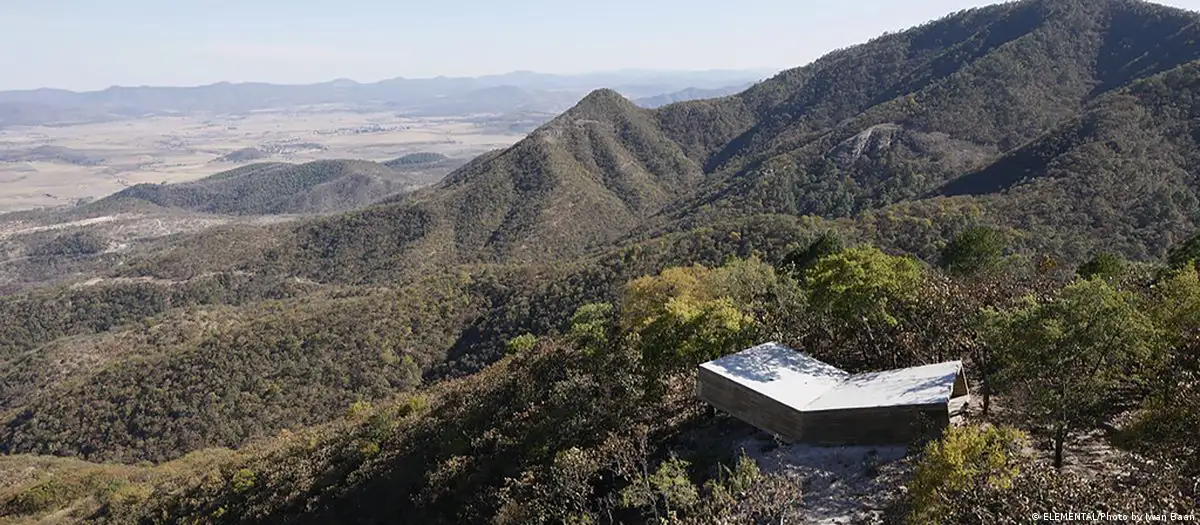
This outlook point is part of Chile's Pilgrim's Route. This small building lies in the middle of nature and is intended to "age with time" - as if it were a natural part of the environment. Equally restrained in form, the structure appears to be like a hollowed-out stone, providing shade to all of those who have walked more than 100 kilometers to the building.