Amazonia's Indigenous peoples dismantle Western cliches
March 20, 2026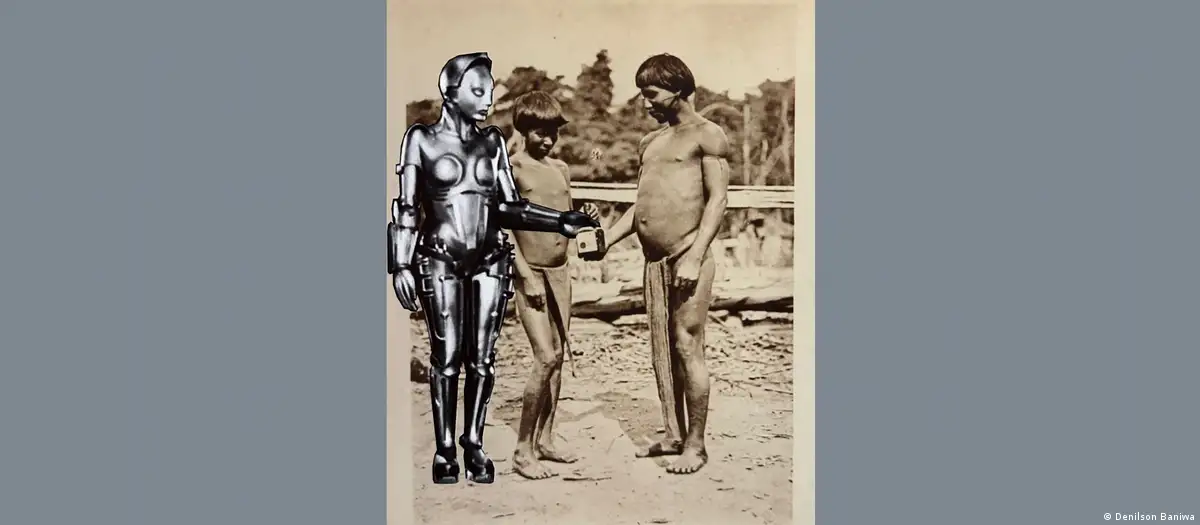
Across history, European depictions of the Amazon have typically presented the South American region as a vast, untouched expanse. Over time, a set of tropes took hold: the rainforest as a "virgin" wilderness; Indigenous life cast as belonging to an earlier era; the whole region suspended outside of time. As a result, a complex, culturally diverse territory has been flattened into an exotic backdrop.
Yet this framing of "the Amazon" as a single, timeless wilderness bears little resemblance to the culturally and historically diverse region of "Amazonia," the titular focus of a new exhibition in Bonn.
A shift in perspective
Co‑curated by anthropologist Leandro Varison and Brazilian Indigenous artist and activist Denilson Baniwa, "Amazonia. Indigenous Worlds" offers an insightful perspective on this part of the world.
The exhibition presents Amazonia as a cultural region shaped by dense networks of exchange, social complexity and relationships that cut across human and "other‑than‑human" worlds.
"Indigenous peoples are often presented as beings outside of history — always the same, never changing. But culture is alive. It develops and changes all the time," Varison tells DW. Thus, instead of following a standard museum chronology, the curators have grouped the exhibits to reflect Indigenous understandings of history — on their own terms.
To be clear, "Amazonia," refers to a wider cultural and historical region spanning Brazil, Bolivia, Peru, Ecuador, Colombia, Venezuela, Guyana, Suriname and French Guiana — broadly aligned with the Amazon Basin and used in many Latin American academic and Indigenous contexts.
It is also one of the most linguistically diverse areas in the world.
Before the European invasions that began in the 16th century, scholars estimate that more than 1,000 languages existed across the region. Today, more than 300 Indigenous languages remain in use, besides signed, whistled and even drummed languages. As Varison notes, it's a striking contrast to the European Union's 24 official languages — and it remains impressive even if you count the more than 60 regional or minority languages that are also still spoken on the continent.
These themes — alongside creation stories, community relations and Indigenous visions for the future — aim to deepen the understanding of Amazônia as a living cultural world rather than a static or isolated one.
Flipping the narrative
Several artworks confront the ways Indigenous peoples have been represented — or erased — in European accounts.
One such incisive piece is "Carta ao Velho Mundo" ("Letter to the Old World" 2018–2019) by the late Macuxi artist and activist Jaider Esbell. He'd come across the first volume of the "Galeria Delta da Pintura Universal" — a 1972 encyclopedia presenting Western art as if it were universal — in a second‑hand bookshop. Across its nearly 400 pages of European masterpieces, he drew, painted and wrote directly onto the reproductions, inserting Indigenous cosmologies, messages of environmental urgency and pointed notes to the "Old World." The result is a decolonizing gesture that challenges the book's claim of presenting a "universal" art history, and exposes how colonial ideas shaped its view of the world.
Denilson Baniwa's "Cacadores de Ficcoes Coloniais" ("Hunters of Colonial Fiction," 2021) uses early anthropological photographs used to classify or exoticize Indigenous peoples, in which he incorporates figures from global pop culture — for instance the "Back to the Future" DeLorean, King Kong, even Godzilla. By inserting these icons into some of the earliest ethnographic images from the Amazon, he creates jarring scenes, ironically questioning how such photographs, collections and anthropological knowledge have shaped stereotypes about Indigenous peoples.
These works also echo another cliche Leandro Varison encounters frequently. "One of the strongest stereotypes is that Indigenous peoples 'belong to the past' or 'don't change,'" he says. Yet, he insists that their use of mobile phones or social networks today does not mean they have "lost their culture" — it means they are adapting on their own terms. "If we Western people have the right to change, why shouldn't they?"
Who 'discovered' whom?
What also comes to the fore is the question of "discovery" itself — and who, in fact, discovered whom.
Research has shown that an estimated several million people lived in Amazonia before colonization, cultivating forest gardens and developing soil‑building practices such as "terra preta" — a fertile, carbon‑rich soil created over centuries through the addition of charcoal, food waste and organic matter.
Archaeology and ecology studies have shown that many iconic tree species — including Brazil nut, cacao and acai — were domesticated and cultivated by Indigenous communities thousands of years before European arrival.
These findings disrupt the old narrative of an untouched wilderness and point to deep, continuous histories of human presence and stewardship of forests.
A different sense of time
The exhibition also touches on how many Indigenous communities understand time and history not as a distant past but as something active in the present, carried through ongoing relationships with ancestors, places and the wider living world. This way of thinking shapes how events are remembered and how communities make sense of their responsibilities today.
Alongside this is an emphasis on relationships — not only with other people, but with what Varison calls "other-than-human beings": spirits, non‑human entities and the many beings that populate Indigenous worlds. It also includes their engagement with those they consider as "Others." "White people" are themselves a relatively recent addition to this category, defined not by their physical traits but by their different way of seeing the world, according to exhibition notes.
Varison also refers to communities who have chosen — in this day and age — to continue to live in isolation.
"Isolated peoples do not belong to the past. They are contemporary people living in the same world as us — they have simply made different choices," Varison says.
Thus, instead of casting Indigenous peoples as figures of an earlier time, the exhibition places their knowledge, practices and ways of relating to the world squarely in the present. It shows how these cultures have carried their histories through upheaval and change, grounding Amazonia not in timelessness but in lived history.
"Amazonia. Indigenous Worlds" runs through to August 9, 2026.
Edited by: Elizabeth Grenier