Blood supplies running low in Germany
January 25, 2026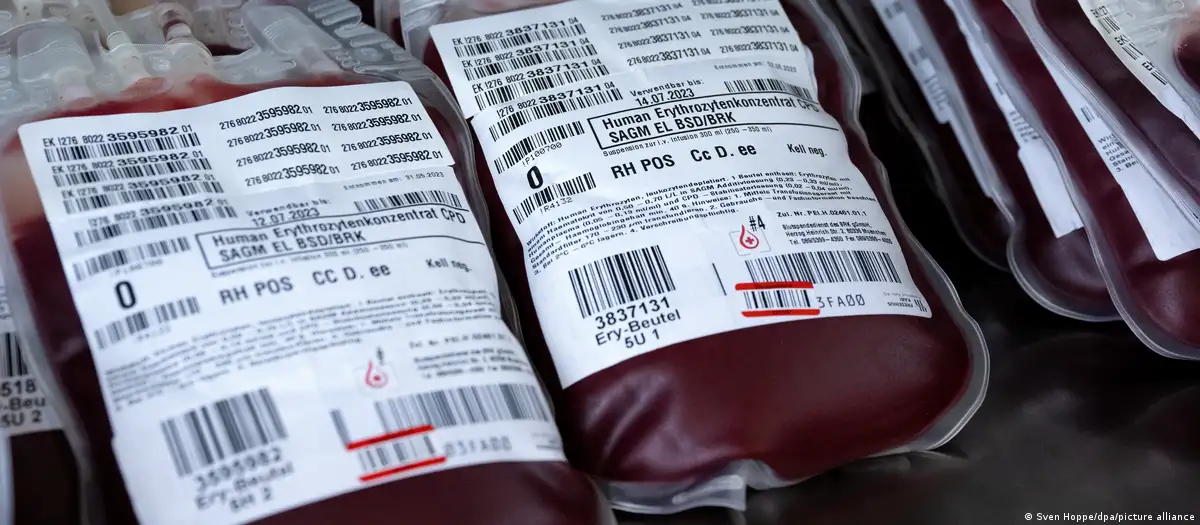
Blood saves lives — after accidents, during operations and in the treatment of serious illnesses such as cancer. According to the German Red Cross (DRK), up to 15,000 donations are needed every day in Germany. In order to be able to help whenever and wherever emergencies arise, supplies should cover at least four days. But time and again, there are shortages.
By mid-January, there were only enough supplies for a day and a half. There were many reasons for this: the Christmas and New Year holidays, and the onset of harsh winter weather with icy roads stopped people from going to donate. Also, the usual wave of illness during the cold season, with many cases of flu and influenza, filled up the hospitals and meant many people were unable or not allowed to donate blood for health reasons.
The German Red Cross sounded the alarm, which prompted me to take decisive action. The last time I had my blood taken was in 1994, 32 years ago. Initially, I thought I was perhaps too old. But that age limit has now been abolished.
No discrimination for donors
The reason for this is encouraging: older people today are often much healthier than in the past. "So why should they stop donating blood?" asks Dr. Sieglinde Ristau at the German Red Cross blood donation center in Berlin's Alexa shopping center. Through a brief conversation, she prepares me for my comeback as a blood donor.
The experienced physician emphasizes that there are no disadvantages to donating blood for healthy people, only advantages. I do some research and learn that numerous studies have proven positive effects on blood pressure and the heart, among other things. Apart from that, it feels good — in a completely unscientific way — to be able to help other people with your blood.
So no one needs to worry about negative consequences. But Ristau has other concerns. "Unfortunately, too few young people are donating," she tells me. And due to the low birth rates since 1990, the lack of young donors could become a problem sooner or later. "That's why we're happy to have older people, who are often the most loyal donors."
I move into the next room, where the head of the German Red Cross blood donation center welcomes me and asks me to take a seat on an adjustable stretcher. After a few brief words about the procedure, Nurse Christina gently inserts the needle into a thick blue vein in my right arm. I hardly feel the prick, and my blood, which flows slowly at first, makes its way easily into a transparent plastic bag.
Blood regenerates quickly
After a few minutes, half a liter of blood has been collected. I feel fine, and one of Christina's colleagues hands me a multivitamin drink. Nevertheless, I am told to lie down for a while to recover. This is because I now have about a tenth less blood in my body; normally, I have between 5 and 6 liters in total.
Within a few days, this temporary and monitored loss will be compensated for as new blood forms quickly. And because it is completely new blood, it is also good for my health, as Christina informs me.
As a farewell gift, I am given a €10 ($11.7) voucher that I can use to buy something to eat in the shopping center. I take this opportunity to ask Kerstin Schweiger about the shortage of life-saving blood reserves. Schweiger, the press spokeswoman for the DRK Blood Donation Service North-East, which covers Berlin, says the situation was critical in mid-January, but now gives the all-clear.
"This has been very successful over the last 10 days," she says. "Nevertheless, we have to keep checking every day, because the big issue is the short shelf life of the blood products obtained from donor blood." Blood donations are safe to use for a maximum of six weeks, but some products can expire in as short as four days.
Red blood cells, plasma and platelets
Schweiger explains the different types to me and what will happen to my blood now. It will be separated into three different parts. In medical lingo, they're called erythrocytes, thrombocytes and leukocytes. To be honest, I'm more familiar with the colloquial terms: red blood cells, blood plasma and platelets.
While red blood cells can be used for 42 days, the platelets that are urgently needed in cancer treatment are only usable for four days.
"That's why it's important in the coming weeks that we remain fully booked so that there are no gaps in patient care," says Schweiger hopefully.
Next shortage may be here soon
Even though the situation has eased somewhat following the German Red Cross' call for help, the next shortage could arise quickly. This is because much of Germany is still experiencing a harsh winter with subzero temperatures, during which many people continue to catch colds or infections.
In addition, school winter holidays begin in Berlin and the neighboring state of Brandenburg at the beginning of February, during which many regular blood donors go on vacation. Times like these are anything but welcome for blood donation services.
This article was originally written in German.
While you're here: Every Tuesday, DW editors round up what is happening in German politics and society. You can sign up here for the weekly email newsletter, Berlin Briefing.