The Olympics and the myth of sporting neutrality
The disqualification of Olympic athlete Vladyslav Heraskevych from Ukraine has been the subject of much debate. But this isn't the first time the Olympics has been used for political messaging.
2026: The 'helmet of remembrance'
Vladyslav Heraskevych shows his helmet depicting images of fallen Ukrainian athletes. The racer was disqualified for refusing to back away from his plan to compete wearing the helmet. The International Olympic Committee considered this a violation of the Olympic Charter, which states "no kind of demonstration or political, religious or racial propaganda is permitted in any Olympic sites."
1936: Nazi games in Berlin
But the Olympics have always been seen as a mirror of the politics of the times. In 1936 German dictator Adolf Hitler used the Olympic Games in Berlin to promote Nazi ideology. The great success of Jesse Owens, a Black US athlete who won four gold medals in track and field that year, dealt a blow to Hitler's attempt to demonstrate supposed Aryan superiority.
1956: Melbourne's 'Blood in the Water' match
The water polo match between Hungary and the Soviet Union at the 1956 Melbourne Olympics ended badly after Hungarian player Ervin Zador left the pool with blood streaming down his face. Just a month prior, Soviet forces had cracked down violently on Hungarian protesters. The game was tense and Zador was punched by a Soviet opponent. The crowd booed and threatened the Soviet team afterwards.
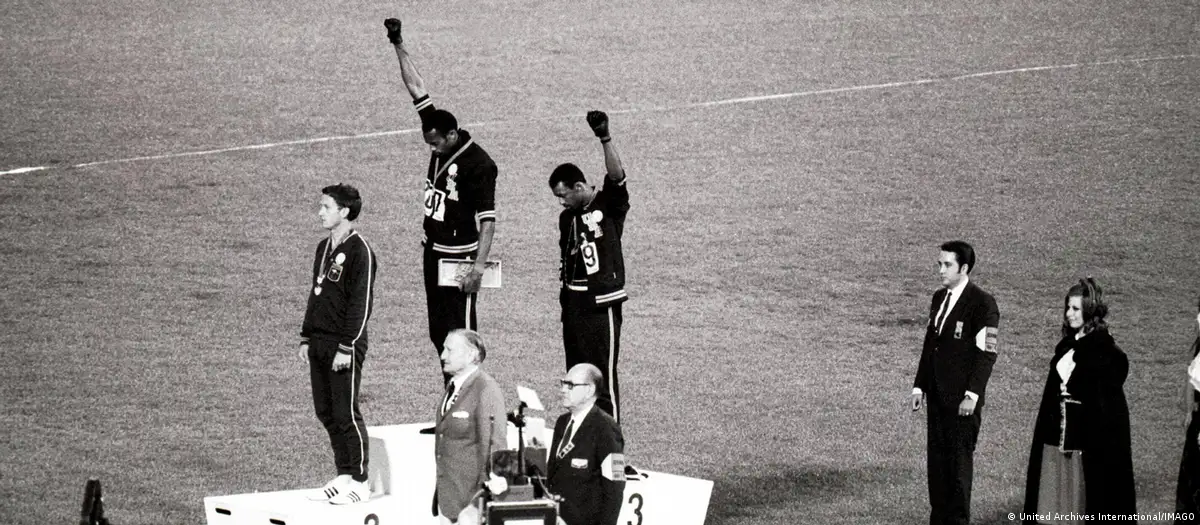
1968: Black power in Mexico City
During the medal ceremony for the 200-meter race, US sprinters Tommie Smith and John Carlos raised their fists in the air. With the Black Power salute, they drew attention to racial discrimination in the US. They were immediately sent home.
1972: Attack on Israeli athletes in Munich
During the Munich Olympics, Palestinian militants affiliated with the Black September group attacked the Israeli Olympic team, killing two and taking nine hostage. A German police operation at the airport, where the extremists attempted to leave with the athlete hostages, was mismanaged. The remaining hostages were killed.
1980: Boycott in Moscow
The Cold War also left its mark. At the end of 1979, the Soviets invaded Afghanistan. The US subsequently decided to boycott the Olympics in Moscow that summer. Sixty-six other countries followed suit and ultimately only 81 nations participated. Some athletes from other countries, including France, Italy and the UK, competed under an Olympic boycott flag.
1984: Los Angeles boycotted by Soviets and their allies
Four years later, Soviet Russia and its allies boycotted the Los Angeles Olympics. A total of 19 nations stayed away, including East Germany. They held their own competing event, the International Friendship Games, in Moscow.
2016: Refugee team in Rio
For the first time, in addition to the individual countries, a 10-member international team of refugees took part in the Olympics — including athletes from the Democratic Republic of Congo and war-torn Syria. The team was created during Europe's so-called refugee crisis in 2015. Similar teams also competed in Tokyo in 2021 and Paris in 2024.
2018: Korean rapprochement in Pyeongchang
South Koreans celebrate being awarded the Olympics in their home country. At the Pyeongchang games, athletes from North and South Korea marched together — at the request of the Olympic Committee — and waved flags depicting the Korean Peninsula. Following the Olympics, talks took place between the two Koreas although nothing concrete resulted.
2024: Neutral Russian athletes in Paris
Sports sanctions against Russia were imposed in 2018 and 2022, with the Olympic Committee accusing the country of state-sponsored doping. In 2024 in Paris, due to the war in Ukraine, Russian athletes were only permitted to compete as individual neutral athletes without their flag or national anthem. Russian trampoline gymnast Angela Bladtseva, pictured above, was one of them.