Diffident rooster, sparrow in your hand — German bird idioms
Many German idioms use bird imagery — there's the proverbial early bird, and plenty of references to cuckoos, pigeons, blind hens and sparrows.
In the hand, on the roof
Don't take unnecessary risks: In a nutshell, that's what the German idiom "Der Spatz in der Hand ist besser als die Taube auf dem Dach" (The sparrow in your hand is better than the pigeon on the roof) means. The popular English equivalent "A bird in the hand is worth two in the bush" is said to go back to the Middle Ages.
The early bird catches the worm
Plan well to your own advantage: "Der frühe Vogel fängt den Wurm" uses the same image in English and German. The idiom is from a 17th-century English collection of proverbs, where the saying goes: "The early bird catches the worm." No birds or worms involved in this one, but Germans also say "Morgenstund' hat Gold im Mund:" literally, the early morning hour has "gold in its mouth."
Crazy loon
When Germans say "Bei dir piept's wohl" (there is something tweeting in your head) or accuse you of having a bird ("Du hast einen Vogel") they are telling you that you must be off your rocker — in a word, crazy. More often than not, the term is accompanied by the above gesture. The imagery possibly goes back to popular belief that demonic creatures were lodged in the heads of mentally ill people.
You've got it made
In German, when you feel someone has done nicely for themselves without lifting a finger, you would say they sat themselves down in a "made nest" ("ins gemachte Nest setzen"). The saying evokes the cuckoo — some female cuckoos lay their eggs in some other bird's nest, and let the unwitting "foster parents" hatch and rear the hungry cuckoo along with their own brood.
Heaven only knows
Exasperated Germans at their wit's end might say, "heaven only knows," but "only the cuckoo (some people say: the vulture) knows" is just as popular. Of course, neither cuckoos nor vultures know or can help. Both were regarded as creepy, slightly demonical birds, so they were used as stand-ins for the being people really did not want to mention by name: the devil.
No one cares two hoots
A common German idiom has it that "Danach kräht kein Hahn mehr" (no rooster crows about this anymore). There's no reason to crow; a person or event has become insignificant, so why bother? The English idiom doesn't use rooster imagery, but does refer to the owl (no one cares two hoots), and the hooting sound it makes — or can't be bothered to utter, in this case.
One swallow does not a summer make
The idiom pointing out that if one good thing happens, it doesn't follow that it will happen again anytime soon, is the same in German. One of Aesop's fables — Aesop was a Greek storyteller in the 6th century B.C. — is said to be the source of the popular proverb. In the story, a young man sees a single swallow in springtime and sells his warm coat — very prematurely, it turns out.
One blind hen
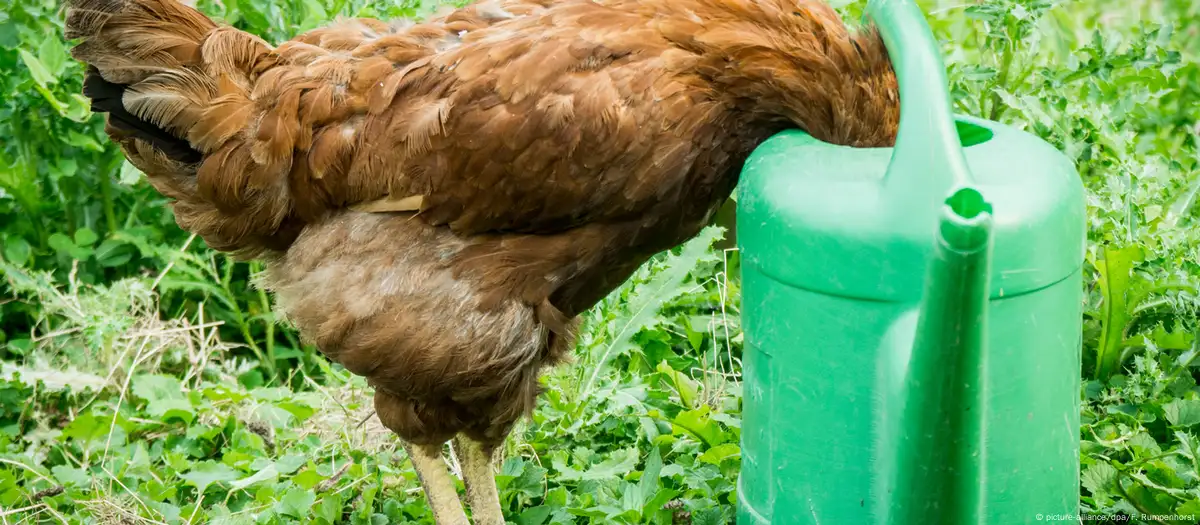
The German idiom "Ein blindes Huhn findet auch ein Korn" (even a blind hen finds a kernel of grain) might sound optimistic, but don't be fooled. Success in this case has nothing to do with skills, but chance and luck. English equivalents include "A blind man may hit the mark, too" and to a certain degree, "Even a broken clock is right twice a day."