Cyprus: Voters boost far right in parliamentary election
May 24, 2026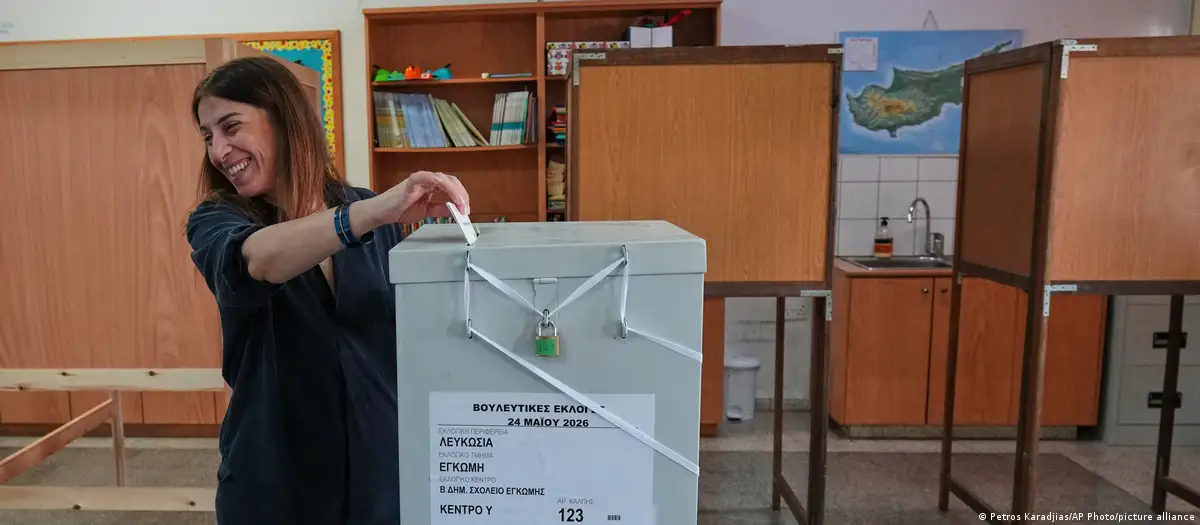
Voters in Cyprus took to the polls on Sunday to elect a new parliament, with more than half a million people eligible to cast ballots.
The vote was seen as a key test of public sentiment ahead of a 2028 presidential race.
Initial results released by the Interior Ministry showed far-right ELAM, an offshoot of Greece's banned Golden Dawn party, with about 11% of the vote, up from 6.8% in the last legislative elections in 2021. If that stands, ELAM would be the third-largest party in the legislature.
The result is unlikely to alter power dynamics immediately, as executive authority remains with the directly elected president Nikos Christodoulides.
But still, three centrist parties that supported president Christodoulides, such as Diko, Dipa and EDEK — suffered losses.
What's at stake in the Cyprus election?
Polling stations opened Sunday as voters choose 56 lawmakers, with seventeen parties are vying for the support of roughly 569,000 eligible voters.
Opinion polls suggest the vote could reshape the political landscape, driven by public frustration over corruption scandals and the rising cost of living.
Three centrist parties — DIKO, DIPA and EDEK — currently back Christodoulides, but polls show weakening support for at least two of them.
Traditional forces such as the conservative DISY and the communist AKEL are also losing ground to newer challengers.
New and smaller parties are expected to gain ground, including the far-right ELAM, centrist reform movement ALMA and the pan-European political party Volt.
Christodoulides, who leads the government, depends on parliamentary backing to pass laws, and weaker results for his allies could complicate governance.
Edited by: Natalie Muller
Don't let the algorithm hide the news. If you rely on our team for trusted reporting, please take a moment to select us as your Preferred Source on Google by clicking here and hitting the "star" or "preferred" button, so you'll always see our verified news first.